How to Pack a Storage Unit Like a Pro: Step by Step
Learn how to pack and organize your storage unit efficiently. Follow these actionable steps to protect your belongings and maximize every square metre.
Most people treat a storage unit like a skip bin with a lock on it. They drag in whatever doesn't fit at home, shove it against the wall, and promise themselves they'll organise it "later." Six months on, they're paying monthly fees to store a pile they can't even walk into. If that sounds familiar, you're not alone, but there's a much smarter way to do this.
Packing a storage unit correctly isn't just about tidiness. It's about protecting what you own, recovering anything you need without dismantling everything else, and genuinely getting value from every square metre you're renting. In Saudi Arabia's climate, where summer temperatures in Riyadh and Jeddah routinely hit 45°C and coastal humidity on the Red Sea coast can quietly destroy fabrics and electronics, how you prepare your belongings before they go into storage matters as much as how you stack them.
This guide walks you through every step, from sorting and packing to labelling, stacking, and maintaining your unit over time. Whether you're a family relocating between Riyadh and Jeddah, an expatriate between contracts, a small business owner needing overflow space, or a contractor working on a Vision 2030 project in AlUla, these steps will help you get the most out of your storage unit from day one.
Step 1: Audit Everything Before It Moves, Don't Store What You Don't Need
Before a single box is taped shut, do a ruthless audit of everything you plan to store. This single step saves more money and frustration than any packing technique. Most people skip it entirely, which is why storage units fill up with broken appliances, duplicate furniture, and items that should have been donated years ago.
Estimated time: 2–4 hours depending on volume
Set up four clear zones in your home or workspace: Keep (going into storage), Donate, Sell, and Discard. Walk through every room and assign each item honestly. The rule of thumb is simple: if you haven't used it in twelve months and it has no sentimental or financial value, it doesn't deserve a paid storage slot.
In the Saudi context, this is especially relevant for expat households preparing to return home. Many families accumulate furniture, appliances, and household goods over several years of living in Jeddah or Riyadh. Shipping everything internationally is expensive; storing everything indefinitely is wasteful. The audit forces a decision on each item rather than letting inertia make the choice by default.
For business owners, the audit serves a different purpose: identifying which inventory lines are genuinely active versus which are dead stock that will never move. Dead stock takes up expensive unit space and ties up capital. If you're using storage as an affordable warehousing alternative in Saudi Arabia, treat it like a warehouse, not a dumping ground.
What You Cannot Store in Saudi Arabia
Reputable storage providers, including WheeKeep, have clear prohibited items lists. Before the audit is complete, make sure nothing on your "Keep" list violates storage terms. Common prohibitions in Saudi Arabia include:
- Flammable or combustible liquids (petrol, paint thinner, aerosols)
- Food and perishables (these attract pests, which then damage everything else in the unit)
- Live plants
- Firearms and ammunition (regulated separately under Saudi law)
- Hazardous chemicals
- Items that are illegal under Saudi law
If you're storing vehicle tyres (common among families with seasonal vehicles), check whether your provider allows this, some do with conditions.
Pro Tip: Photograph Everything Before Storage
Before anything goes into a box, photograph high-value items, electronics, antiques, appliances, jewellery (if permitted). Store these photos in a cloud folder labelled with the storage date. This creates a simple condition record that matters if you ever need to make an insurance claim or dispute a damage question later.
Step 2: Gather the Right Packing Supplies, The Saudi Climate Demands More Than Cardboard
Standard cardboard boxes and bubble wrap are a starting point, not a complete solution. In Saudi Arabia's climate, inadequate packing materials are the primary reason belongings come out of storage in worse condition than they went in. The extreme heat, dust, and humidity variations between coastal and inland cities require a more deliberate approach to materials.
Estimated time: 30–60 minutes to source and gather materials
Here's what you'll actually need:
| Material | Best For | Saudi Climate Note |
|---|---|---|
| Double-walled cardboard boxes | General household items | Resists compression better in heat; single-wall boxes collapse under weight when warm |
| Plastic airtight containers (PP or HDPE) | Clothes, documents, linens, electronics | Blocks dust and moisture; essential near Jeddah's coastal humidity |
| Bubble wrap (large cell) | Fragile items, glassware, ceramics | Wrap loosely, tightly wrapped bubble wrap can trap moisture |
| Furniture blankets / moving pads | Sofas, tables, cabinets, appliances | Protects surfaces from dust and abrasion; breathable (unlike plastic wrap) |
| Silica gel packs | Inside boxes with electronics, leather, instruments | Absorbs moisture in sealed containers; critical in coastal storage locations |
| Stretch wrap / plastic film | Bundling drawers, wrapping appliance doors | Don't wrap fabric or wood directly, it traps heat and moisture |
| Acid-free tissue paper | Artwork, photographs, books | Regular newspaper ink transfers in heat; use acid-free only |
| Wardrobe boxes (tall, with hanging rail) | Suits, abayas, thobes, formal wear | Prevents fold creases and fabric stress |
| Heavy-duty packing tape + dispenser | Sealing all boxes | Cheap tape loses adhesion above 40°C, use industrial-grade |
You can source most of these materials from Tamimi Markets, Panda, IKEA Riyadh or IKEA Jeddah, or specialised moving supply shops in industrial areas of Dammam and Khobar. Some storage providers, including WheeKeep, can advise on local suppliers when you book your unit.
Avoid: Using newspaper as wrapping (ink transfers), thin plastic shopping bags as padding, and single-use supermarket bags to "seal" boxes. These look like solutions but create problems months later.
Step 3: Choose the Right Unit Size, and Understand What You're Actually Paying For
Getting the unit size right is the single biggest financial decision in the storage process. Too small and you'll either cram things dangerously or rent a second unit. Too large and you're paying for air. Most first-time storage renters either underestimate by 20% or overestimate by 30%, based on common patterns seen across storage markets.
Estimated time: 20–30 minutes to measure and calculate
At WheeKeep, the three standard unit configurations work as follows:
| Unit Type | Dimensions (L×W×H) | Price (SAR/month) | Best For |
|---|---|---|---|
| Small | 2.4 × 1.5 × 2.35 m | 599 SAR/mo | Students, young professionals, small office archive, seasonal items from a 1–2 bedroom flat |
| Medium ⭐ Most Popular | 3.6 × 1.5 × 2.35 m | 899 SAR/mo | Families between moves, e-commerce inventory, contents of a 2–3 bedroom apartment |
| Large | 3.6 × 2.4 × 2.5 m | 1,289 SAR/mo | Full household furniture, business equipment, contractor tools, renovation overflow |
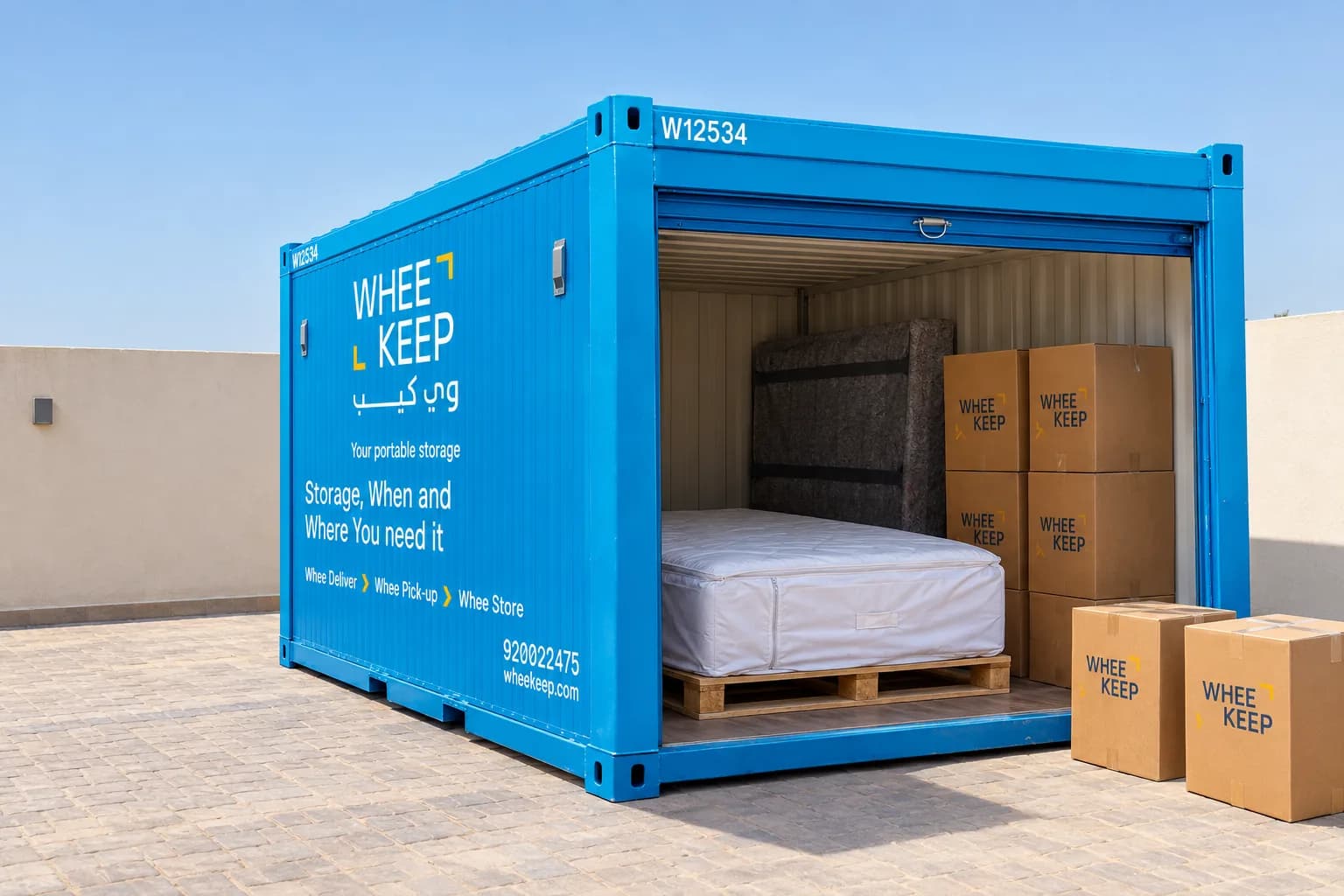
All WheeKeep units are available with no long-term contract, cancel anytime, and include a padlock, CCTV monitoring, and on-demand return of your belongings.
How to Estimate Your Volume Accurately
Rather than guessing, list your items by category and use approximate cubic metre volumes:
- King-size bed (frame + mattress): approximately 2.5–3 cubic metres
- 3-seater sofa: approximately 2–2.5 cubic metres
- Wardrobe (double, flat-packed): approximately 1–1.5 cubic metres
- Dining table + 6 chairs: approximately 2–3 cubic metres
- Standard cardboard box (medium): approximately 0.07 cubic metres
- Refrigerator (family size): approximately 0.8–1.2 cubic metres
- Washing machine: approximately 0.6–0.8 cubic metres
Add 20% to your total estimate for the gaps you can't eliminate when stacking irregular shapes. That buffer is what separates a unit you can actually use from one that's jammed to the ceiling with no access corridor.
If you're unsure, the WheeKeep team at either the Jeddah Hub (serving Jeddah and the surrounding Red Sea coast region) or Riyadh Boulevard Hub can help you choose the right size before you book. Getting this right from the start saves you from upgrading mid-contract.
Ready to reserve your unit? WheeKeep operates Sun–Thu 09:00–21:00 and Sat 12:00–20:00. Visit wheekeep.com to check availability at your nearest location, Jeddah Hub, Asfan, Riyadh, or Boulevard Hub, and lock in your size before you start packing.
Step 4: Pack Boxes Correctly, Density, Weight, and Labelling That Actually Works
Poorly packed boxes are the number one cause of storage unit damage that has nothing to do with the facility itself. Crushed boxes collapse under weight, unlabelled boxes become archaeological digs, and overpacked boxes injure backs during loading. This step is where most guides give generic advice, this one gives you the system that actually works in practice.
Estimated time: 1–3 hours per room, depending on volume
The Weight Rule
Every box should be liftable by one person without straining. In practical terms:
- Heavy items (books, tools, canned goods): use small boxes. A small box of books is manageable; a large box of books is a back injury waiting to happen.
- Light items (pillows, duvets, light clothing): use large boxes. They fill volume without adding unsafe weight.
- Mixed boxes: put heavy items at the bottom, lighter items on top. This applies both inside each box and when stacking boxes in the unit.
The No-Void Rule
Empty space inside a box is a structural weakness. When boxes stack, the weight from above compresses the void and collapses the box walls. Fill every gap with packing paper, clothing, or foam. If a box rattles when you shake it, something will break. If it flexes under hand pressure, it needs more filler.
The Labelling System That Saves Time Later
Generic labels like "Kitchen" or "Miscellaneous" are useless when you need to find one specific item six weeks after packing. Use this four-part label format on every box:
- Room/Category: Kitchen – Utensils
- Contents summary (3–5 items): Pots, strainer, spice rack, wooden spoons
- Priority number: 1 = likely to need soon; 3 = can wait months. This determines where it goes in the unit.
- Fragile indicator: Mark all four vertical sides AND the top face if fragile.
Write labels on at least two sides of the box (not just the top). When boxes are stacked four high in a unit, you can only read the sides. Use a thick permanent marker, fine-point pens become unreadable in six months. For long-term storage, also photograph each box's label before it goes into the unit and file these in a folder labelled with the storage date.
Category-Specific Packing Notes
Electronics: Original boxes are ideal. If unavailable, wrap in anti-static bubble wrap (not standard bubble wrap, which can build static charge). Remove batteries from all devices, in Saudi Arabia's heat, batteries can expand and leak, corroding contacts. Label cables with masking tape before coiling them.
Clothing and Textiles: Vacuum storage bags compress bedding and seasonal clothing dramatically, freeing significant space. However, avoid vacuum-sealing leather items, which need to breathe. Traditional garments, abayas, thobes, formal wear, are best stored in wardrobe boxes hanging vertically rather than folded, to preserve fabric structure.
Furniture: Disassemble anything that can be flat-packed. Remove table legs, take apart bed frames, and remove sofa legs where possible. Keep all screws and fittings in a small zip-lock bag taped directly to the piece they belong to. Photograph the assembled item before disassembly if you're unsure you'll remember how it goes back together.
Artwork and Mirrors: Wrap in acid-free tissue first, then bubble wrap. Store vertically, never flat, flat storage invites stacking, which cracks frames and glass. Create a "picture rack" against one wall using padded dividers.
Books and Documents: Store books flat or spine-down (not spine-up, which damages the binding). Important documents go in sealed plastic containers with a silica gel pack inside. In Saudi Arabia, relevant documents, residency permits (iqama), property papers, tenancy agreements, business licences issued by the Ministry of Commerce, should always be stored in airtight containers, never loose in cardboard.
Step 5: Create a Floor Plan Before You Load a Single Item
The order in which items enter a storage unit determines whether the unit is functional or frustrating for its entire rental period. Improvising the layout on moving day, when you're tired and working against time, produces a unit where everything you need is at the back and everything you won't touch for a year is at the front.
Estimated time: 20–30 minutes to sketch and plan
Measure your unit dimensions before loading day (WheeKeep provides exact dimensions per unit type at booking). Sketch a simple top-down floor plan, even a rough hand drawing works. Mark the following zones:
- Back zone: Items you won't need until you fully vacate the unit. Furniture you're not using, archived boxes, seasonal items.
- Middle zone: Items you might need occasionally, business inventory that moves slowly, seasonal clothing, equipment used a few times a year.
- Front zone (within 1 metre of the door): Priority 1 items. Anything you might need to retrieve on a weekday without fully entering the unit.
- Access corridor: Leave a 60–80 cm walkway down the centre of the unit. This is not wasted space, it's what allows you to reach the middle and back zones without unloading the front.
The Stack-Height Rule
Never stack boxes higher than 1.8 metres unless they are on shelving. Freestanding stacks above 1.8 metres are unstable and become dangerous in a confined unit. If you want to use the full ceiling height (WheeKeep's large units reach 2.5 metres), invest in a set of metal shelving units, available from IKEA, Tamimi, or industrial suppliers in Jeddah's Al-Bawadi district or Riyadh's industrial zones near the Eastern Ring Road.
Furniture as Architecture
Large furniture pieces are not just items to store, they're structural elements of your unit layout. Use them strategically:
- Place wardrobes and tall bookcases against the back and side walls, using their internal shelves to store smaller boxes and items inside them.
- Sofas can be stored on end vertically (check the manufacturer's guidance) to save floor space.
- Dining tables with removable legs can be stood upright against a wall, freeing significant floor area.
- Chest freezers and large appliances go in first, pushed to the back wall, because they are heavy, awkward, and you almost certainly won't need them until you fully exit the unit.
Shelving: The Single Best Investment for a Storage Unit
A set of steel shelving units (around 180 cm tall, 90 cm wide, 40 cm deep) converts a standard storage unit from a pile into a proper organised space. Shelving allows you to:
- Use vertical space without unstable box towers
- Access any box without moving others
- Keep the floor clear for furniture and appliances
- Separate categories visually, making retrieval fast
The cost of two or three shelving units is recovered quickly in reduced time spent searching and in the ability to use a smaller (cheaper) unit more efficiently, a direct way to maximize storage unit space and keep monthly costs down.
Step 6: Load the Unit Strategically, Sequence, Weight Distribution, and Climate Positioning
Loading sequence is where planning meets physical reality, and small mistakes here compound into large problems over time. The goal is a unit where nothing is crushing anything else, weight is distributed safely, and the items most likely to be affected by heat are positioned where conditions are most stable.
Estimated time: 2–6 hours depending on unit size and volume of items
The Loading Sequence
- Heavy appliances and furniture first: Refrigerators, washing machines, large cabinets. These go against the back wall. Lay appliances on their sides only if the manufacturer permits it, many compressors in fridges require upright storage.
- Flat-packed furniture second: Bed frames, table tops, and panels store efficiently leaning against walls. Stand them vertically, padded with furniture blankets, and secure them so they can't fall.
- Heavy boxes third: Place on the floor, against the walls. Never stack heavy boxes on top of lighter ones or on top of furniture that can't bear weight.
- Medium boxes fourth: Stack on top of heavy boxes, filling in the middle zones.
- Light, bulky items last: Pillows, duvets, lampshades, and soft bags fill the remaining gaps and can sit on top of stacks without adding dangerous weight.
- Frequently accessed items: Place these last so they sit closest to the door. Priority 1 boxes go in the front zone, within arm's reach.
Climate Positioning Inside the Unit
Even within a single storage unit, temperature distribution isn't perfectly uniform. In Saudi Arabia's climate, the following positioning principles apply:
- Electronics and sensitive items: Position away from the unit door (which faces the outside environment) and away from any external wall that receives direct sun. The centre and back of the unit is more thermally stable.
- Metal items: Metal conducts and retains heat. Don't stack boxes directly on bare metal shelving without a cardboard layer between them.
- Leather furniture: Position where air can circulate around it. Don't press leather directly against walls or wrap it tightly in plastic.
- Wooden furniture: Wood expands and contracts with temperature and humidity changes. Leave small gaps between wooden pieces and walls to allow for this movement and prevent warping.
WheeKeep facilities include CCTV coverage throughout, and the padlock system ensures only you have access to your unit. However, the internal environment of your unit is primarily shaped by how well you've packed and positioned items, not the facility itself, so this step genuinely matters.
Step 7: Protect Specific Item Categories for Long-Term Saudi Storage
Generic storage advice rarely accounts for how Saudi Arabia's specific climate conditions affect different material types over time. This section covers the item categories most commonly damaged in storage, and what to do differently.
Estimated time: Variable, build this into your overall packing time
Wooden Furniture
Clean all wood thoroughly before storage, oil, dust, and food residue attract insects and accelerate deterioration. Apply a light coat of furniture wax or polish to sealed wood surfaces. Avoid plastic sheeting directly against wood, it traps moisture and causes swelling. Use breathable furniture blankets instead. For antique or high-value wood pieces, consider cedar blocks inside or near the piece as a natural insect deterrent.
Upholstered Furniture
Clean fabric surfaces and treat with a fabric protector spray before storage. Allow pieces to dry fully before covering, damp fabric in a sealed space grows mould quickly, especially if the unit is in Jeddah's more humid coastal environment. Cover with breathable cotton dust sheets, not plastic. Plastic traps moisture and creates exactly the conditions that produce mildew.
Electronics
Remove all batteries. Wrap screens in anti-static material. Place silica gel packs inside any boxes containing electronics. If storing computers, remove hard drives and keep them separately in a static-free bag, this protects your data even if the machine itself is damaged. Televisions should be stored upright, never flat, and ideally in their original foam packaging if available.
Documents and Records
For Saudi residents, this category deserves particular care. Documents including property deeds, iqama records, business registration certificates from MISA (Ministry of Investment), vehicle ownership papers, and educational certificates should be stored in sealed, rigid plastic document boxes with moisture-absorbing inserts. Scan everything digitally before storage, not as a replacement for the physical documents, but as a backup that ensures you can function if something goes wrong.
Clothing and Textiles
Wash everything before storage, body oils and food residue attract insects and cause fabric deterioration over time. Store clean, dry items only. For Ramadan or Hajj-season clothing that may be stored between annual use, add cedar or lavender sachets to deter moths. Don't store clothes in black bin bags, they trap heat and moisture and are too easy to accidentally discard.
Musical Instruments
String instruments (oud, guitar, violin) are particularly vulnerable to temperature fluctuations, which cause wood to crack and glue joints to fail. If you're storing instruments for more than a few weeks, loosen string tension before storage. Keep instruments in hard cases, never soft bags, and include a small humidifier pack if the instrument manufacturer recommends a specific humidity range.
Need storage for a renovation, relocation, or business expansion? WheeKeep's medium unit at 899 SAR/month is the most popular choice for Saudi families and business owners, no long-term contract, padlock included, CCTV monitored. Check availability now at wheekeep.com across Jeddah Hub, Asfan, Riyadh, and Boulevard Hub locations.
Step 8: Create a Master Inventory, The System That Pays for Itself
A storage unit without an inventory is a black box that costs you money every time you need something. You either pay in time (searching through boxes) or in frustration (giving up and buying a replacement for something you know is in there somewhere). The master inventory takes an hour to create and saves that time many times over.
Estimated time: 30–60 minutes, done during packing
The most practical format is a shared spreadsheet (Google Sheets works well) with the following columns:
| Column | What to Record | Example Entry |
|---|---|---|
| Box/Item ID | Sequential number matching the box label | Box 14 |
| Category | Room or type | Kitchen |
| Contents | Specific items inside | Pots (3), colander, wooden spoon set, spice rack |
| Location in unit | Front/middle/back, shelf level | Middle zone, shelf 2, left side |
| Priority | 1 (soon), 2 (occasional), 3 (long-term) | 2 |
| Approximate value | SAR estimate for insurance purposes | 350 SAR |
| Notes | Fragile, disassembled, special instructions | Pot lids wrapped separately in Box 15 |
Keep this spreadsheet accessible on your phone. When you need to retrieve something, search the spreadsheet rather than opening the unit and guessing. When you add or remove items, update the spreadsheet on the same visit. This discipline takes two minutes per visit and saves significant time over a multi-month rental.
For business owners using storage units in Riyadh or Jeddah as affordable warehousing, this inventory doubles as a stock record that can feed into basic accounting. Knowing exactly what's in storage, what it's worth, and when it was placed there is useful for both operations and tax records managed under ZATCA (Zakat, Tax and Customs Authority) requirements.
Step 9: Ongoing Maintenance, What to Do After Move-In Day
The work of good storage doesn't end when the last box goes in. A storage unit needs periodic attention, especially in Saudi Arabia's climate, to ensure belongings remain in the condition they were stored in. This step is almost universally skipped by first-time storage users, and it's where preventable damage occurs.
Frequency: Monthly check-ins recommended; quarterly for long-term storage
Monthly Visual Check
On a monthly visit, walk through the unit with the following checklist:
- ✅ No boxes showing signs of compression or collapse at the bottom of stacks
- ✅ No visible moisture, condensation, or water marks on boxes or furniture
- ✅ No signs of pest activity (droppings, chewed material, nesting)
- ✅ No unusual odours (musty smell indicates moisture; chemical smell may indicate a product has leaked)
- ✅ Furniture blankets and covers are still in place and haven't slipped
- ✅ Access corridor is still clear and walkable
If you spot any of these issues early, they're almost always fixable without significant damage. Caught late, moisture or pest damage can destroy entire box stacks.
Seasonal Adjustments
Saudi Arabia has two distinct storage seasons. From May through September, the extreme heat in Riyadh and the Eastern Province (Dammam, Khobar, Dhahran) and the coastal humidity in Jeddah create the most challenging conditions. During this period:
- Check silica gel packs and replace them if they've become saturated (most change colour when spent)
- Inspect any items with natural materials, wood, leather, paper, more carefully
- Ensure nothing heat-sensitive (certain plastics, candles, wax items) has deformed or melted
From October through March, conditions are generally milder and storage is lower maintenance. This is also the period when many families in Saudi Arabia take the opportunity to rotate seasonal items, summer sports equipment out, winter clothing and blankets in.
Updating Your Inventory After Each Visit
Every time you remove something from the unit or add something new, update your master inventory before leaving. It takes two minutes and prevents the inventory from becoming outdated and therefore useless. This is especially important for business owners managing inventory through their storage unit, where accurate stock records have financial and compliance implications.
Step 10: Plan Your Exit Before You Sign the Lease
The best time to plan how you'll exit a storage unit is before you move in. This sounds counterintuitive, but it's one of the clearest differentiators between people who use storage efficiently and those who end up with units they're paying for indefinitely because clearing them feels overwhelming.
Estimated time: 30 minutes of planning before move-in
Define your exit trigger before signing. Common triggers for Saudi residents include:
- Completion of a home renovation (typical duration: 2–4 months for an apartment, 4–8 months for a villa)
- End of an overseas posting or expatriate contract
- Move-in date for a new property in Riyadh, Jeddah, or another city
- Seasonal end date (Hajj season, academic year, project completion)
- A business milestone (securing a permanent warehouse lease, expanding operations)
Because WheeKeep operates with no long-term contract, you're never locked in. Cancel anytime means you can exit when your trigger is reached without financial penalty. But having a defined trigger in mind keeps you from drifting into indefinite storage, paying month after month for belongings you've essentially forgotten.
When exit day comes, reverse the loading sequence: retrieve front-zone items first, work back toward the rear. Your master inventory tells you exactly what's where, so the process is systematic rather than chaotic. Donate or sell anything that's been in storage for more than twelve months and hasn't been retrieved once, if you haven't needed it in a year, you probably don't need it.
How WheeKeep Makes Self Storage in Saudi Arabia Simpler
Following these ten steps gives you a storage unit that works as a genuine asset rather than a costly inconvenience. But the facility you choose matters too. Self storage in Saudi Arabia has evolved significantly, and the difference between a basic lock-up and a properly managed facility is real.
WheeKeep operates four locations serving the Kingdom's most active urban centres:
- WheeKeep Jeddah Hub, serving Jeddah's residential and commercial districts along the Red Sea coast (coordinates: 21.61865076556873, 39.13091624240242)
- WheeKeep Asfan, serving Jeddah's northern expansion zone and surrounding areas (coordinates: 21.808103739333482, 39.43077899716639)
- WheeKeep Riyadh, serving the Saudi capital's southern and central zones (coordinates: 24.55849608344948, 46.474216866772544)
- WheeKeep Boulevard Hub (Riyadh), serving northern Riyadh and the Boulevard district (coordinates: 24.779993152312215, 46.60675958995404)
Every unit comes with a padlock, 24-hour CCTV monitoring, and on-demand return of your items. Pricing runs from 599 SAR/month for a small unit to 1,289 SAR/month for a large unit, with the medium unit at 899 SAR/month being the most popular choice for families and small businesses. No long-term contracts. No hidden setup fees.
Whether you need storage units in Jeddah for a home renovation, storage units in Riyadh for a business inventory solution, or affordable storage units in Saudi Arabia during a relocation, WheeKeep's flexible terms mean you only pay for what you need, for as long as you need it.
For those managing larger logistics, WheeKeep's on-demand return service means you don't need to physically visit the unit every time you need something retrieved, a meaningful benefit for business owners, for families managing a complex move, or for contractors working on remote Vision 2030 sites who need stored equipment delivered to location.
Frequently Asked Questions About Packing and Using Storage Units in Saudi Arabia
How far in advance should I book a storage unit before my moving date?
Book at least one week in advance, and two weeks if you're moving during peak periods, Ramadan (when many families reorganise), the summer months (May–August, when expat transitions peak), and the academic year start in September. WheeKeep locations across Riyadh and Jeddah can fill quickly during these periods. Booking early also gives you time to gather packing materials properly rather than rushing the process.
Can I access my WheeKeep storage unit on Fridays?
WheeKeep is closed on Fridays. Operating hours are Sunday through Thursday 09:00–21:00 and Saturday 12:00–20:00. Plan retrieval visits accordingly. If you need regular weekend access, Saturday visits between 12:00 and 20:00 are your best option.
What's the most common mistake people make when packing a storage unit?
Loading without a plan. Most unit users carry items in as they arrive, placing them wherever there's space, without any system. The result is a unit where frequently needed items are at the back and the front zone is blocked by furniture. Spending twenty minutes sketching a floor plan before loading day prevents this entirely.
Is cardboard safe for long-term storage in Saudi Arabia's heat?
Double-walled cardboard is acceptable for most household items, but it has limits in Saudi Arabia's climate. In high-humidity environments like Jeddah, cardboard can soften and lose structural integrity over time. For items you're storing for more than three months, or for anything fragile or high-value, use sealed plastic containers instead. Cardboard is fine for shorter-term storage in climate-stable conditions.
How do I protect my furniture from the heat in a storage unit?
Use breathable furniture blankets rather than plastic sheeting, plastic traps heat and moisture against wood and fabric surfaces. Apply a protective wax or polish to wooden furniture before storage. Keep upholstered items away from direct contact with external walls, which conduct heat. In WheeKeep's managed facilities, the environment is maintained to reduce temperature extremes, but good preparation on your part adds an additional layer of protection.
Can I store business inventory in a WheeKeep unit instead of a warehouse?
Yes, and many small and medium-sized businesses in Riyadh and Jeddah use WheeKeep units as an affordable storage alternative to commercial warehousing. The medium unit (3.6×1.5×2.35 m at 899 SAR/month) and large unit (3.6×2.4×2.5 m at 1,289 SAR/month) work well for product inventory, seasonal stock, equipment, and document archives. The no-contract model means you can scale up or down as your business needs change, particularly useful for e-commerce sellers managing seasonal demand fluctuations.
What items should I absolutely not store in a Saudi storage unit?
Never store flammable liquids (petrol, paint thinner, aerosols), food or perishables, live plants, chemicals, or items prohibited under Saudi law. These either create fire and safety hazards or attract pests that then damage everything else in the unit. Most storage providers, including WheeKeep, specify these prohibitions clearly in their rental terms.
How do I prevent pests from getting into my stored items?
Three rules: store nothing edible, seal everything in airtight containers where possible, and don't bring items that are already infested into the unit (check secondhand furniture carefully before storage). Cedar blocks and lavender sachets deter moths in clothing storage. Inspect the unit on regular check-ins, early detection of any pest activity prevents spread. WheeKeep's managed facilities include regular facility maintenance, but unit-level protection starts with your packing.
Is it worth buying shelving units for a storage unit?
Yes, for anything beyond a few weeks of storage. Shelving is the single most effective way to maximize storage unit space because it converts unused vertical space into accessible storage without creating unstable box towers. Two standard steel shelving units (available from IKEA Riyadh or IKEA Jeddah) cost around 200–400 SAR and can be reused at your next home or office. The ROI in time saved and damage prevented is significant.
Can expatriates leaving Saudi Arabia use storage for items they want to leave behind?
Absolutely. This is one of WheeKeep's most common use cases. Expats between contracts or relocating temporarily store furniture, vehicles (check terms), and household goods rather than shipping everything home. The no-contract model means you're not paying for longer than you need. WheeKeep's Jeddah Hub and Riyadh locations are particularly popular with the expat communities in those cities.
How should I organise a storage unit that I'll be accessing regularly for business?
Treat it like a small warehouse. Use floor-to-ceiling shelving along the side walls, leaving a central corridor for access. Label everything by SKU or product category, not just by box number. Keep a digital inventory updated after every visit. Position fast-moving stock closest to the door and slow-moving or archived stock at the rear. Consider a dedicated shelf for items awaiting return or exchange. This system makes regular access fast and efficient rather than disruptive.
What's the minimum storage rental period at WheeKeep?
WheeKeep operates on a monthly basis with no long-term contract requirement. You can cancel anytime, making it suitable for short-term needs, a renovation that runs two months, a seasonal transition, or a business project with a defined end date, as well as open-ended situations where you're not sure how long you'll need the space.
Key Takeaways for Packing and Using Storage Units in Saudi Arabia
- Audit before you pack: Don't pay to store items you don't need. The pre-storage audit is the highest-leverage step in the entire process.
- Climate-proof your packing: Saudi Arabia's heat and coastal humidity demand better materials than standard cardboard alone. Use sealed plastic containers, silica gel packs, and breathable covers for furniture.
- Choose the right unit size: Measure and calculate your volume needs before booking. A 20% buffer above your estimate prevents the need to upgrade mid-rental.
- Pack boxes correctly: Heavy items in small boxes, light items in large boxes. Fill all voids. Label all four sides with category, contents, and priority.
- Plan your layout before loading: Sketch a floor plan with front, middle, and back zones. Reserve an access corridor. Use shelving to exploit vertical space.
- Load in reverse retrieval order: Last things in should be the first things you'll need. Everything else builds behind it.
- Maintain a master inventory: A simple spreadsheet updated after every visit saves significant time and prevents the "I know it's in there somewhere" problem.
- Check in regularly: Monthly visual checks catch moisture, pest activity, and structural issues before they become expensive damage.
- Plan your exit trigger: Define the event that ends your storage rental before you sign. This prevents indefinite storage drift.
- Choose a managed facility: The difference between a secure, maintained facility and a basic lock-up matters for long-term storage. WheeKeep's CCTV, padlock system, and on-demand return service provide genuine operational value.
When storage is done well, it's invisible, you don't think about it because everything is where it should be, protected, accessible, and accounted for. When it's done poorly, it becomes a recurring source of cost, frustration, and damage. The ten steps in this guide give you the system to ensure your storage unit in Saudi Arabia works for you, not against you.
Ready to get started? Book your WheeKeep unit online at your preferred location, Jeddah Hub, Asfan, Riyadh, or Boulevard Hub, with no long-term commitment and flexible monthly terms starting from 599 SAR/month.