How to Choose the Right Storage Unit Size in Saudi Arabia
Not sure what storage unit size you need? Follow this step-by-step guide to pick the perfect WheeKeep unit for your home, office, or business in Saudi Arabia.
Picture this: you've just signed a lease on a new flat in Riyadh's Al Malqa district, your moving date is three weeks away, and you're standing in your living room staring at a sofa, a dining set, six years of accumulated belongings, and a very real question, how much storage space do you actually need? Book too small a unit and you're back to square one, cramming boxes into a space that won't close. Book too large and you're paying for empty air every month. Getting the size right from the start saves money, reduces stress, and means your belongings are always within reach when you need them.
This guide walks Saudi residents through every step of choosing the right storage unit size, from doing a proper inventory of your belongings, to matching those belongings against real unit dimensions, to understanding which WheeKeep unit size fits your specific situation. Whether you're a family in Jeddah preparing for a renovation, an expatriate manager in Dammam between postings, an e-commerce seller in Riyadh needing affordable overflow space, or a contractor working on a Vision 2030 project in AlUla, the framework here applies directly to your circumstances.
Why Size Is the Most Important Decision You'll Make About Storage
Choosing the right storage unit size is more consequential than choosing the facility itself. A well-located, well-secured facility means very little if the unit you've booked can't physically accommodate your belongings, or if you're paying a monthly premium for three metres of unused floor space. In the Saudi context, where summer heat between May and September regularly reaches 45–50°C in Riyadh and the Eastern Province, and where moving windows are often compressed into early mornings or cooler winter months, wasted trips back to the facility because you misjudged capacity are genuinely costly.
The good news is that choosing the right size is a solvable problem. It requires three things: a clear inventory of what you're storing, an understanding of how those items translate into cubic metres, and an honest assessment of how you'll need to access your belongings while they're in storage. Work through those three questions methodically and the right unit size becomes obvious.
The Cost of Getting It Wrong in Both Directions
Undersizing is the more common mistake. People estimate optimistically, pack the unit to the ceiling with no walkway, and then find they cannot retrieve a single item without unpacking everything. This defeats the core purpose of self-storage, which is accessibility. A storage unit that functions as a sealed container is just an expensive cardboard box.
Oversizing is less operationally painful but financially wasteful. If you rent a large unit when a medium would have sufficed, you're paying an additional 390 SAR per month, nearly 4,680 SAR per year, for empty space. Over an 18-month renovation project in a Jeddah villa, that adds up to a meaningful sum. The WheeKeep pricing structure (599 SAR/month for small, 899 SAR/month for medium, 1,289 SAR/month for large) makes the stakes of that decision concrete and calculable.
Why Saudi Living Conditions Affect Unit Size Differently
Saudi households typically run larger than the regional average. Multi-generational family homes in Riyadh's Al Rawdah or Jeddah's Al Hamra districts often contain substantial furniture, extensive household goods, and seasonal items (winter clothing, Eid decorations, Hajj preparation equipment) that simply don't exist in equivalent quantities in smaller Western apartments. An expatriate family relocating from a compound villa in Dhahran may be storing more cubic metres of furniture than a comparable family in a European flat, yet assume their storage needs are "average."
Factor in the seasonal nature of Saudi storage needs, the surge in demand around Ramadan and Eid Al-Fitr when families reorganise homes, the summer relocation season when school terms end, and the Hajj period when Makkah and Medina residents temporarily vacate properties, and accurate size estimation becomes even more important. Units fill quickly during peak periods, and upgrading mid-rental is not always immediately possible.
Step One: Building Your Storage Inventory (The Right Way)
Before you can answer the question "what size storage unit do I need," you need a complete picture of everything you plan to store. This step is where most people cut corners, and it's why most size miscalculations happen. A proper inventory takes 45–90 minutes for a typical household and is the single highest-return preparation activity in the entire storage process.
Room-by-Room Inventory Method
Walk through your home or office room by room and list every item you intend to store. Don't rely on memory, physically open cupboards, check under beds, and look inside storage ottomans. Saudi homes often contain items accumulated over years of hosting, including large quantities of extra bedding, guest furniture, and kitchen equipment used only during Ramadan or for large family gatherings.
For each room, group items into three categories:
- Furniture (bulky, structural items): Sofas, beds, wardrobes, dining tables, desks, bookshelves
- Boxable items: Books, kitchenware, clothing, linens, décor, documents
- Irregular or oversized items: Bicycles, pushchairs, outdoor furniture, gym equipment, rolled rugs, large art
Furniture drives unit size requirements more than anything else. A single king-size bed frame and mattress takes up roughly the same floor space as 15–20 standard moving boxes. Identify all furniture pieces first, then assess how boxes will stack around and on top of them.
Estimating Box Count
A useful rule of thumb: a fully furnished bedroom in a typical Saudi family home generates 20–35 standard moving boxes of personal items. A kitchen generates 15–25 boxes. A living room with décor and electronics generates 10–20 boxes. These figures assume proper packing, items wrapped and consolidated, not loosely placed in oversized boxes.
Once you have your box count and furniture list, you have the raw material to size your unit accurately. The sections below translate those raw figures into specific unit recommendations.
The "Access Requirement" Question
Before finalising your inventory list, answer this question honestly: how often will you need to access items in your unit? If you're storing furniture during a 3-month renovation and will retrieve it all at once when the project finishes, you can pack densely with no access corridor. If you're running an e-commerce business from your WheeKeep unit and need to retrieve stock multiple times per week, you need a clear walkway down the centre of the unit and items arranged by retrieval frequency. The access requirement can push you up one size tier even when the cubic volume would technically fit in a smaller unit.
Step Two: Understanding WheeKeep's Unit Sizes and Dimensions
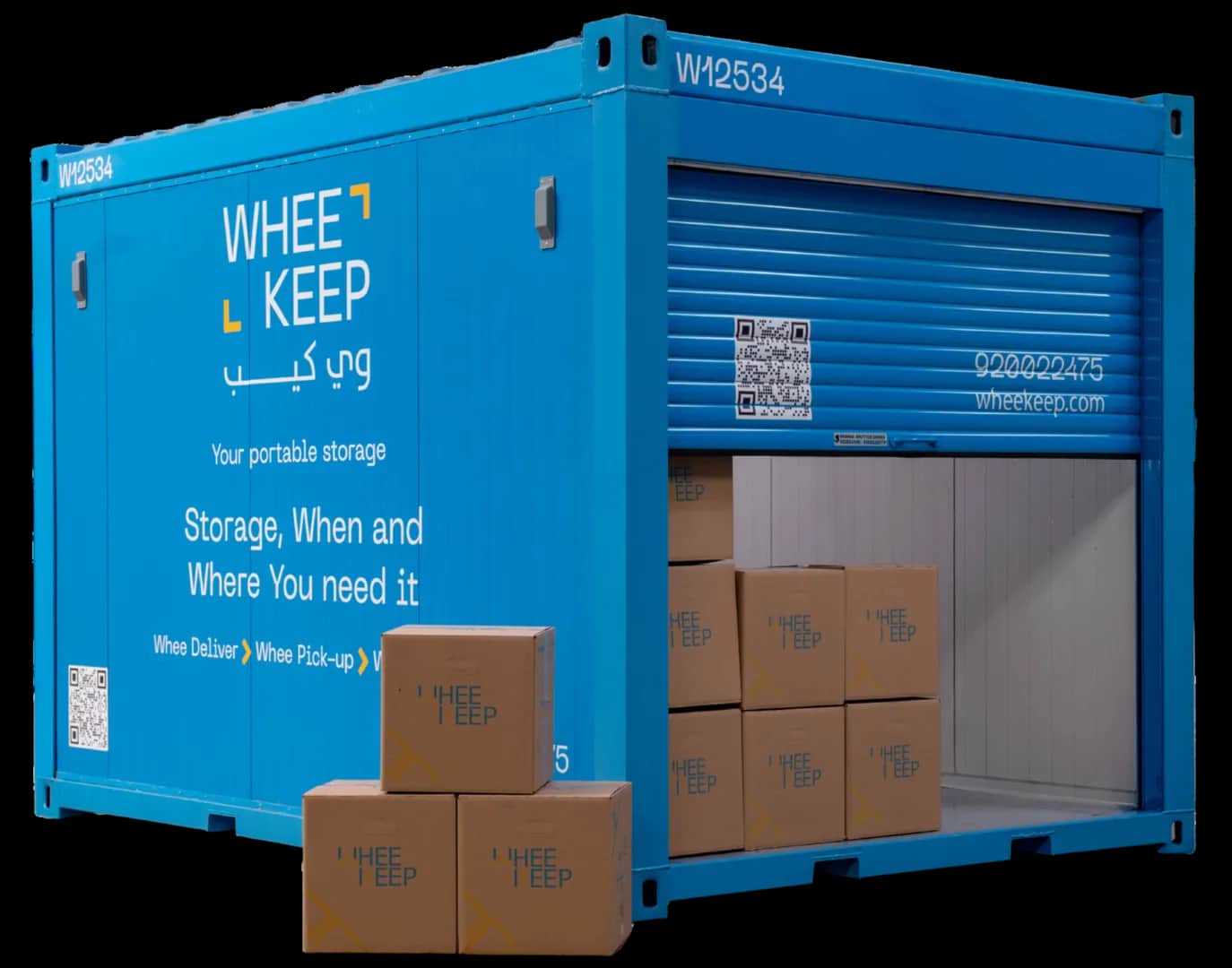
WheeKeep offers three core unit sizes, each with specific dimensions that determine real-world capacity. Understanding what those dimensions mean in practice, not just on paper, is the bridge between your inventory list and the right booking decision.
| Unit Size | Dimensions (L×W×H) | Floor Area | Cubic Volume | Monthly Price | Best For |
|---|---|---|---|---|---|
| Small | 2.4 × 1.5 × 2.35 m | 3.6 m² | ~8.5 m³ | 599 SAR/mo | Studio/1-bed contents, seasonal items, small office clearance |
| Medium | 3.6 × 1.5 × 2.35 m | 5.4 m² | ~12.7 m³ | 899 SAR/mo | 2–3 bedroom household, small business inventory, renovation storage |
| Large | 3.6 × 2.4 × 2.5 m | 8.64 m² | ~21.6 m³ | 1,289 SAR/mo | Full family home (4+ beds), large business stock, vehicle-adjacent storage |
Every WheeKeep unit comes with a padlock, 24-hour CCTV surveillance, and on-demand return service, included in the monthly price with no long-term contract required. You can cancel at any time, which makes it practical to start with one size and adjust if your needs change.
What "Floor Area" Actually Means for Packing
Floor area numbers are useful but slightly misleading in isolation. The usable cubic volume depends heavily on how high you can stack items safely. WheeKeep's small and medium units have a 2.35 m ceiling, which allows for stacking to approximately 1.8–2.0 m with a stable configuration (leaving a safety margin at the top). The large unit's 2.5 m ceiling gives slightly more vertical headroom and is particularly useful for items like wardrobe carcasses stored upright, or shelving units that exceed the 2.35 m ceiling of the smaller units.
In practice, most customers achieve usable packing densities of around 60–70% of total cubic volume, because some space is inevitably lost to irregular shapes, access corridors, and items that cannot be safely stacked. The practical guidance section below accounts for this reality rather than presenting theoretical maximum figures.
The Medium Unit: Why It's the Most Popular
WheeKeep's medium unit (3.6 × 1.5 × 2.35 m, 899 SAR/month) is the most popular size for good reason. It occupies a sweet spot between cost and capacity that suits the majority of storage scenarios in Saudi Arabia: a family temporarily clearing a two-bedroom apartment in Jeddah, a small business storing 3–4 months of product inventory, or an expatriate between housing assignments in Riyadh's Diplomatic Quarter. The extra 1.2 metres of length compared to the small unit translates to meaningful additional floor space for an extra piece of furniture or an additional row of boxes, and at 300 SAR more per month than the small unit, the cost-per-cubic-metre is actually lower.
Step Three: Matching Your Inventory to the Right Unit Size
With your inventory list in hand and the unit dimensions clear, the matching process becomes systematic. The table below provides scenario-based guidance drawn from common storage situations across Saudi Arabia's major cities.
The Small Unit (2.4×1.5×2.35 m, 599 SAR/month): What Fits
The small unit is the right choice when your storage needs are genuinely compact. It suits:
- A studio apartment or one-bedroom flat in Al Aziziyah (Jeddah) or Al Aqiq (Riyadh), think a single bed, a small desk, a wardrobe, and 15–20 moving boxes
- Seasonal items only, winter clothing, Eid decorations, Ramadan table sets, guest bedding for a family of four
- Office clearance for a small team, four to six office chairs, a desk, filing cabinets, and document boxes
- E-commerce stock for a startup seller on Noon or Amazon.sa managing 50–150 SKUs of small-to-medium products
- Students and young professionals storing belongings during a summer return to a home city, or during a move between furnished and unfurnished accommodation
The small unit is not suitable for any sofa larger than a two-seater, a double bed plus wardrobe combination, or more than 20–25 standard moving boxes. If your inventory includes a dining table with chairs, you have almost certainly outgrown the small unit.
The Medium Unit (3.6×1.5×2.35 m, 899 SAR/month): The Versatile Choice
The medium unit handles the broadest range of storage scenarios. It comfortably accommodates:
- A two-bedroom apartment or flat, including a king-size bed, a three-piece sofa set, a dining table for six, two wardrobes, and 40–60 moving boxes
- A three-bedroom villa clearance if furniture is disassembled and items are packed efficiently
- Small business inventory, product stock for a boutique retail operation, a Jeddah-based fashion reseller, or a Riyadh home-goods business running through Instagram Commerce
- Renovation storage for a mid-sized apartment undergoing kitchen and bathroom refurbishment over 6–12 weeks
- Contractor equipment for a small team working on projects in Diriyah Gate or similar heritage redevelopment sites
- Expatriate household, contents of a company-provided apartment being vacated between postings in Riyadh or Dammam
If you are a family in Jeddah or Riyadh reading this and you're unsure whether to book a small or medium unit, the medium is almost always the right call. The 300 SAR monthly difference is far less disruptive than discovering your furniture won't fit and having to arrange a same-day upgrade or a second unit.
Ready to book? WheeKeep's medium unit at 899 SAR/month is available at the Jeddah Hub, Riyadh, Asfan, and Boulevard Hub locations. No long-term contract, start storing on your schedule. Reserve your unit at WheeKeep today.
The Large Unit (3.6×2.4×2.5 m, 1,289 SAR/month): When You Need the Full Space
The large unit is designed for situations where volume is the primary constraint. It suits:
- A full family villa (four or more bedrooms), multiple sofas, beds, wardrobes, a large dining set, kitchen appliances, and 80–120 moving boxes
- Growing businesses managing significant inventory volumes, a Riyadh-based distributor, a Jeddah importer clearing goods through the Islamic Port, or an e-commerce operation scaling from 200+ SKUs
- Long-term storage during extended overseas assignments or multi-year construction projects
- Retail overflow storage for a chain with a branch in a shopping mall needing seasonal stock management around National Day (23 September), Eid, and the winter tourist season
- Vision 2030 project teams, contractors and project managers working in AlUla, NEOM, or the Red Sea Project who need a secure base for equipment and materials between project phases
The Storage Unit Size Decision Framework
To make the selection process even more concrete, use this decision framework. Answer each question in sequence, your answers will lead you to a clear size recommendation without guesswork.
| Question | Your Answer | Suggested Unit |
|---|---|---|
| Are you storing only seasonal or overflow items (no furniture)? | ✅ Yes | Small (599 SAR/mo) |
| Are you storing a studio or 1-bed flat's contents? | ✅ Yes | Small (599 SAR/mo) |
| Storing a 2–3 bedroom apartment or flat? | ✅ Yes | Medium (899 SAR/mo) |
| Small business inventory (under 100 SKUs, low volume)? | ✅ Yes | Small–Medium (599–899 SAR/mo) |
| Storing a full villa (4+ bedrooms) or large family home? | ✅ Yes | Large (1,289 SAR/mo) |
| Do you need frequent access (weekly or more)? | ✅ Yes | Go up one size tier to ensure access corridor |
| Is your inventory primarily boxes with minimal large furniture? | ✅ Yes | Stay at your calculated tier (boxes stack efficiently) |
| Do you have oversized items (gym equipment, large rugs, outdoor furniture)? | ✅ Yes | Go up one size tier minimum |
Scenario Profiles: Finding Yourself in the Data
Abstract frameworks are useful, but real-world scenarios are more instructive. The following profiles cover the most common storage situations encountered by Saudi residents and expatriates across Jeddah, Riyadh, Dammam, Makkah, and Medina.
Scenario A: The Jeddah Family Undergoing Villa Renovation
A family of five in Al Rawabi (Jeddah) is renovating their ground floor, new flooring, kitchen refit, and structural changes to the majlis. The renovation is expected to take 10–14 weeks. They need to store the contents of three ground-floor rooms: the living room (large L-shaped sofa, two armchairs, a large TV console, a coffee table), the dining room (dining table for 10, sideboard, display cabinet), and the kitchen (appliances, extensive cookware, pantry goods). Bedrooms remain in use upstairs and don't need storage.
Recommendation: Large unit (1,289 SAR/month). The majlis furniture alone, particularly an L-shaped sofa and a 10-person dining table, is bulky enough to fill a medium unit with little room remaining. The sideboard, display cabinet, and kitchen appliances push the total into large-unit territory. For 10–14 weeks, the total cost is approximately 3,225–4,515 SAR, which is significantly less than renting temporary accommodation to keep the family in the home during the work.
Scenario B: The Riyadh Expatriate Between Postings
A corporate manager has completed a three-year posting in Riyadh and is moving to a furnished apartment for six months before a new assignment begins. They need to store the contents of a two-bedroom flat: a king bed, a three-piece sofa, a dining set for four, two wardrobes, a desk, and approximately 40 moving boxes of personal items.
Recommendation: Medium unit (899 SAR/month). This is a textbook medium-unit scenario. The furniture list is substantial but not excessive, and the box count is well within the medium unit's capacity with efficient packing. Over six months, the total cost is 5,394 SAR, a fraction of the cost of maintaining a full apartment lease just to store belongings.
Scenario C: The E-Commerce Seller Scaling Up
An entrepreneur selling home accessories through Noon and their own website operates from a home in Riyadh's Al Nakheel district. They've grown from 30 SKUs to 180, and product boxes are taking over two spare rooms. They need dedicated storage with easy access three to four times per week for order fulfilment.
Recommendation: Medium unit (899 SAR/month), with strong consideration for large (1,289 SAR/month). The frequent access requirement is the deciding factor here. Even if 180 SKUs of home accessories could technically fit in a small unit, the practical need to locate, retrieve, and restock items multiple times per week demands a clear walkway and organised shelf access. The medium unit's additional length (3.6 m vs 2.4 m) allows for a shelving run down one wall with a clear aisle, the most efficient configuration for active inventory management. If stock volumes continue to grow, the large unit becomes necessary within 3–6 months and pre-booking at that tier avoids a disruptive mid-season upgrade.
Scenario D: The Seasonal Pilgrim Accommodation Manager
A property manager in Makkah's Al Aziziyah district rents furnished apartments to Hajj and Umrah pilgrims throughout the year. Between pilgrim groups, she needs to store 15 sets of bedding, towels, prayer mats, kitchen basics, and portable furniture items used to configure rooms differently for family versus group bookings.
Recommendation: Small unit (599 SAR/month). Bedding, linens, and soft goods pack exceptionally efficiently. Fifteen sets of bedding and associated soft items, along with flat-pack furniture components, fit comfortably within the small unit's 8.5 m³ of usable space. At 599 SAR/month with no long-term contract, this provides a flexible, cost-effective solution that can be maintained year-round or paused during peak occupancy periods.
Scenario E: The Dammam SME Moving to Larger Office Premises
A small engineering consultancy in Dammam's Khobar district is relocating from a 150 m² office to a 300 m² space in a new commercial tower. During the 6-week fit-out period, they need to store the contents of the existing office: 12 workstations, filing cabinets, a conference table, IT equipment (packed), and document archives.
Recommendation: Large unit (1,289 SAR/month). Commercial furniture is invariably bulkier than residential equivalents. Twelve workstations, even disassembled, occupy significant floor space. A conference table for 10 is a single item that can fill a substantial portion of a medium unit's floor area. Combined with filing cabinets and document boxes, the large unit is the appropriate choice. At 6 weeks, the total cost is approximately 1,934 SAR, significantly less than paying double rent on both premises simultaneously.
Common Mistakes to Avoid When Estimating Storage Size
Even with a solid inventory and a clear decision framework, certain errors recur consistently. Being aware of them in advance prevents costly surprises on moving day.
Mistake 1: Measuring Only Floor Space, Not Height
Saudi households often contain tall items, display cabinets that reach 2.2 m, large refrigerators, standing wardrobes. If you have items taller than 2.0 m, they cannot be stored on their side without occupying a full unit-width of floor space. Check the ceiling height of your chosen unit (2.35 m for small and medium, 2.5 m for large) against your tallest items before booking.
Mistake 2: Forgetting Disassembly Potential
Most flat-pack furniture, IKEA wardrobes, bed frames, shelving units, can be disassembled to reduce volume by 40–60%. A wardrobe that stands 2.2 m tall and 1.0 m wide when assembled becomes a flat stack of panels roughly 0.2 m thick when disassembled. If your inventory estimate includes assembled furniture, recalculate after accounting for what can realistically be taken apart. This can drop you from a large to a medium unit requirement.
Mistake 3: Not Accounting for Packing Quality
Loosely packed boxes with air gaps, oddly shaped items stuffed into oversized containers, and fragile goods that require extra padding all reduce effective packing density. Professional packing services typically achieve 20–30% better space utilisation than self-packing. If you're packing yourself under time pressure, common during Ramadan when days are shorter and energy levels lower, build in an additional 15–20% buffer on your estimated volume.
Mistake 4: Ignoring Future Additions
Many customers start a storage rental with one set of items and then add more over time, a piece of furniture from a relative's home, new purchases that don't fit in a renovated space, additional business inventory. If there's any realistic chance you'll be adding to your stored items within the first 3 months, size up by one tier. The marginal cost is far less than the logistics of transferring everything to a larger unit mid-rental.
Mistake 5: Treating All Box Sizes as Equivalent
A standard large moving box (approximately 60 × 40 × 40 cm) occupies roughly 0.096 m³. A small moving box (40 × 30 × 30 cm) occupies approximately 0.036 m³. If your box inventory is a mix of sizes, which it almost always is, your total box volume is not simply "number of boxes × one box size." Count your large, medium, and small boxes separately and calculate accordingly, or use the practical room-based estimates provided in Step One above.
Packing Strategies That Maximise Your Unit's Effective Space
Choosing the right size unit is only half the equation. Packing your unit efficiently ensures you get the full value of the space you're paying for, and that you can actually retrieve items when you need them. These strategies apply across all three WheeKeep unit sizes.
The Perimeter-First Method
Place your largest, heaviest items against the back wall and side walls first, working from the perimeter inward. This creates a stable structural base and leaves the centre of the unit accessible. Tall furniture should go against the back wall; medium-height items against the side walls; boxes and small items fill the centre, stacked to maximum safe height. This method works particularly well in WheeKeep's medium unit, where the 3.6 m length allows for a clear central corridor when items are arranged against the long walls.
Vertical Stacking Rules
Boxes should be stacked with the heaviest at the bottom and the lightest at the top, standard advice, but frequently ignored in the rush of a move. More importantly, stacks should not exceed 1.5 m without a lateral brace (such as a shelf unit alongside the stack). Boxes stacked to 2.0 m or beyond become unstable, particularly in the temperature fluctuations common in Saudi Arabia, where units can experience significant heat variation if accessed after a summer day.
Label Everything on the Side, Not the Top
When boxes are stacked, the top label is invisible. Label all four sides of every box so that the contents are identifiable regardless of how the box is oriented or what's stacked next to it. Use a consistent colour-coding system by room (blue for kitchen, red for master bedroom, green for children's room) and you'll navigate your unit in seconds rather than minutes.
Furniture Protection in the Saudi Climate
Saudi Arabia's summer heat, particularly in Riyadh and the Eastern Province where temperatures regularly exceed 45°C outdoors, does not penetrate well-constructed, climate-managed storage facilities, but it's still worth protecting wooden furniture and leather upholstery from any temperature fluctuations. Use furniture blankets, breathable cotton covers for sofas (avoid plastic wrap, which traps moisture even in low-humidity environments like Riyadh), and place silica gel packets in sealed boxes containing electronics or documents.
Storing with WheeKeep? All units come with a padlock, CCTV monitoring, and on-demand return service. No long-term commitment, pay monthly and cancel when you're done. Check availability at your nearest WheeKeep location.
How to Choose the Right Storage Unit Size for Business Use in Saudi Arabia
Business storage in Saudi Arabia presents a distinct set of considerations from residential use. The question of what size storage unit is needed for commercial purposes depends on inventory turnover, access frequency, and growth trajectory, not just current volume.
Inventory Turnover Rate as the Primary Driver
A business storing slow-moving stock (seasonal merchandise, archival documents, surplus equipment) can pack its unit to near-maximum density because access is infrequent. A business using its unit as an active fulfilment hub, picking and packing orders daily, as many Noon and Amazon.sa sellers do, needs a unit that functions as a workspace as much as a storage space. For active fulfilment, the practical rule is to use no more than 60% of the unit's floor area for shelving and stock, leaving 40% as working space and access corridors.
The Growth Projection Test
Saudi e-commerce has grown substantially over recent years, driven by Vision 2030's digital economy agenda and the rapid adoption of online retail among Saudi consumers. For any business that is growing, the right unit size is not the size that fits your current inventory, it's the size that fits your projected inventory 6–12 months from now. Upgrading mid-lease is operationally disruptive: it requires relocating all stock, potentially during a peak trading period. Size up conservatively at the start of the rental to avoid this scenario.
Document Storage and Compliance Considerations
Saudi businesses subject to ZATCA (Zakat, Tax and Customs Authority) record-keeping requirements must retain financial documents for a minimum period. Physical document storage is a common use case for small and medium WheeKeep units, particularly for SMEs in Riyadh and Jeddah that lack adequate on-site archive space. Standard A4 document boxes (approximately 33 × 26 × 26 cm) stack efficiently and are among the most space-efficient items to store. A small WheeKeep unit can accommodate several years of document archives for a small business, at a cost that is far lower than commercial office space.
Import and Logistics Buffer Storage
Businesses importing goods through Jeddah Islamic Port or King Abdulaziz Port in Dammam often face timing mismatches between customs clearance and retail or delivery readiness. A WheeKeep unit serves as a cost-effective buffer between port clearance and final distribution, without the overhead of a formal warehouse lease. For importers working with last-mile carriers like SMSA, Zajil, or AJEX, a WheeKeep unit in Jeddah or Riyadh provides a local consolidation point that simplifies last-mile operations.
Location Matters: Choosing the Right WheeKeep Facility
Unit size and unit location are separate decisions, but they interact. Choosing the right size unit at the wrong location creates access friction that undermines the entire value of self-storage. WheeKeep currently operates four locations across Saudi Arabia's two largest cities:
- WheeKeep Jeddah Hub, centrally positioned to serve central and southern Jeddah, including Al Hamra, Al Rawabi, Al Zahraa, and Al Aziziyah districts
- WheeKeep Asfan, serves northern Jeddah and the Asfan corridor, convenient for residents of Al Marwah, Al Shati, and surrounding neighbourhoods
- WheeKeep Riyadh, positioned to serve central and southern Riyadh, including Al Malqa, Al Rawdah, and the commercial districts around King Fahd Road
- WheeKeep Boulevard Hub (Riyadh), serves northern Riyadh, including Hittin, Al Nakheel, Ar Rahmaniyah, and the rapidly developing Al Qirawan corridor
When selecting your unit, choose the location closest to your primary access point, your home, your office, or your most frequent delivery address. WheeKeep is open Sunday through Thursday from 09:00 to 21:00, and on Saturday from 12:00 to 20:00. Friday is closed, which aligns with the Saudi weekend structure.
Frequently Asked Questions About Storage Unit Sizes in Saudi Arabia
How do I know what size storage unit I need?
Start by building a complete inventory of everything you plan to store, grouped into furniture, boxable items, and oversized items. Furniture drives unit size requirements more than anything else. Once you have your list, use WheeKeep's three unit tiers as a guide: small (2.4×1.5×2.35 m) for studios and seasonal items, medium (3.6×1.5×2.35 m) for 2–3 bedroom apartments, and large (3.6×2.4×2.5 m) for full family villas or significant business inventory.
Is the medium unit big enough for a two-bedroom apartment?
Yes, in most cases. WheeKeep's medium unit (3.6×1.5×2.35 m, 899 SAR/month) comfortably accommodates the contents of a two-bedroom apartment, including a king-size bed, a three-piece sofa, a dining set for four to six, two wardrobes, and 40–60 moving boxes, provided items are packed efficiently and flat-pack furniture is disassembled where possible.
Can I store business inventory in a WheeKeep unit?
Yes. WheeKeep units are used by e-commerce sellers, importers, retailers, and SMEs across Jeddah and Riyadh for inventory storage. The medium unit is the most popular for active fulfilment operations, while the large unit suits higher-volume businesses. All units include CCTV and padlock security as standard.
What is the cheapest storage unit at WheeKeep?
The small unit (2.4×1.5×2.35 m) is priced at 599 SAR per month with no long-term contract. It suits studios, seasonal items, small office clearances, and compact e-commerce inventory.
Can I upgrade my unit size after moving in?
WheeKeep's flexible, no-long-term-contract model is designed to accommodate changing needs. Contact WheeKeep directly to discuss availability of a larger unit at your chosen location. To avoid the disruption of a mid-rental transfer, it's generally better to size up slightly at the outset if there is any realistic chance your needs will grow.
What items cannot be stored in a WheeKeep unit?
Standard self-storage restrictions apply: hazardous materials, flammable substances, perishable food items, live animals, and illegal goods cannot be stored. Contact WheeKeep for a complete list of prohibited items specific to their facilities.
Is self storage in Saudi Arabia available year-round?
Yes. WheeKeep operates year-round at all four locations. Access hours are Sunday–Thursday 09:00–21:00 and Saturday 12:00–20:00. Facilities are closed on Fridays. During Ramadan, business hours may adjust, contact WheeKeep to confirm current operating schedules during holy month periods.
Can I store Hajj or Umrah equipment at WheeKeep?
Yes. Ihram garments, prayer mats, portable cooking equipment, and related pilgrimage items are common storage contents at WheeKeep facilities. The small unit is typically sufficient for a family's Hajj or Umrah kit between pilgrimages.
Does WheeKeep provide moving services as well as storage?
Yes. WheeKeep offers both self-storage and moving services. Combining the two under one provider simplifies the logistics of a relocation or renovation, with a single point of contact for both transportation and storage needs.
What is the minimum rental period at WheeKeep?
WheeKeep operates on a flexible monthly basis with no long-term contract required. You can cancel at any time, making it suitable for both short-term needs (a 6-week renovation) and long-term storage (an extended overseas posting).
Key Takeaways
- Inventory first, size second. Never estimate a unit size without a complete, room-by-room list of everything you're storing. Furniture items are the primary driver of unit size, boxes are secondary.
- The medium unit (899 SAR/month) is the right choice for most Saudi households. It handles 2–3 bedroom apartments, renovation clearances, and small business inventory with room to spare.
- Access frequency matters as much as volume. If you need frequent access to your stored items, go up one size tier to ensure a usable access corridor, a cramped unit that you can't navigate negates the purpose of self-storage.
- Disassemble flat-pack furniture before estimating your volume. This can reduce your apparent storage requirement by one full size tier.
- For businesses, size for 6–12 months of growth, not current inventory. Upgrading mid-rental during a peak trading period is operationally disruptive and avoidable.
- WheeKeep's no-contract model means you're never locked in, but sizing correctly from the start avoids the logistics of a mid-rental transfer.
- All four WheeKeep locations (Jeddah Hub, Asfan, Riyadh, and Boulevard Hub Riyadh) are open Sunday–Thursday 09:00–21:00 and Saturday 12:00–20:00, with padlock security, CCTV, and on-demand return included at every tier.
Your Next Step: Book the Right WheeKeep Unit Today
You now have every tool you need to make this decision with confidence. Run the inventory, apply the decision framework, match your scenario to the profiles above, and book the unit that fits, not the one that almost fits. The difference between a correctly sized unit and a compromised one is measured in convenience, accessibility, and monthly cost every single time you visit your stored belongings.
WheeKeep offers storage units across Jeddah and Riyadh with no long-term contracts, competitive monthly pricing from 599 SAR, and a service designed around the real needs of Saudi families, expatriates, and businesses. Whether you're storing the contents of a Jeddah villa during a renovation, managing inventory for a growing Riyadh e-commerce business, or simply clearing space for a life transition, the right unit is ready when you are.
Reserve your WheeKeep storage unit now, when and where you need it.