E-Commerce Inventory Storage in Saudi Arabia: A Guide
Running an online store in Saudi Arabia? Explore how self-storage units give e-commerce sellers a cost-effective, scalable alternative to traditional warehousing.
Picture this: it is 22:30 on a Tuesday evening and a seller running a growing online store on Noon and Amazon.sa is surrounded by flat-pack boxes stacked three rows deep in the spare bedroom of a Jeddah apartment. Orders are picking up ahead of Eid. A supplier in Dammam just delivered a pallet of seasonal goods two weeks early. The living room is no longer a living room. The car stays on the street because the garage is now a fulfilment centre. Sound familiar?
This is the reality for thousands of e-commerce sellers across Saudi Arabia right now. The Kingdom's digital commerce market is expanding at a pace that regularly outstrips a seller's ability to organise physical inventory. Demand is real, sales are growing, but the storage situation is quietly strangling the business before it has a chance to scale. The question is not whether you need a better storage arrangement. The question is which arrangement makes commercial sense for a seller who is not yet ready to sign a multi-year warehouse lease in an industrial district.
This guide covers everything a Saudi-based online seller needs to know about e-commerce storage in Saudi Arabia: the true cost of the options available, how to think about scalability, what to look for in a facility, and why self-storage units are emerging as the most practical middle ground between chaotic home storage and expensive industrial warehousing.
Why Inventory Storage Has Become a Critical Problem for Saudi E-Commerce Sellers
Storage is not a glamorous problem. It sits quietly in the background while sellers focus on product sourcing, marketing, and customer service. But it compounds quickly. The moment a seller starts holding more than a few weeks of stock, the absence of a proper storage system starts costing money in ways that are easy to miss.
Saudi Arabia's e-commerce landscape has undergone a structural shift over the past several years. Vision 2030 has accelerated digital infrastructure, smartphone penetration is among the highest in the region, and platforms like Noon, Amazon.sa, Salla, and Zid have dramatically lowered the barrier to entry for independent sellers. The result is a large and growing cohort of small and medium-sized online businesses operating from Riyadh, Jeddah, Dammam, Khobar, and dozens of smaller cities, many of whom built their operations without any formal inventory management system in place.
The problems that follow tend to cluster into four categories:
- Space exhaustion: Home-based sellers run out of usable space faster than they anticipate, especially in urban apartments in Riyadh's northern districts or Jeddah's coastal neighbourhoods where square footage is at a premium.
- Stock damage: Saudi summers are brutal. Temperatures in Riyadh and the Eastern Province regularly exceed 45°C between May and September. Goods stored in unventilated garages, outdoor sheds, or non-climate-controlled spaces deteriorate rapidly, particularly electronics, cosmetics, apparel, and food-adjacent products.
- Operational disorganisation: When inventory is spread across a bedroom, a car boot, and a relative's garage, fulfilment errors multiply. Wrong items get shipped, stock counts become unreliable, and refund rates climb.
- Scaling bottlenecks: A seller who needs to double inventory ahead of a major sales event, such as the Saudi National Day on 23 September or the White Friday period, has no elastic capacity if they are already maxed out at home.
The conventional answer to this problem is to rent commercial warehouse space. But for a seller turning over 50,000–200,000 SAR a month, a traditional warehouse lease in an industrial zone on Jeddah's northern ring road or near Riyadh's logistics cluster typically requires a minimum lease term of twelve months, upfront deposits, and a monthly cost that makes sense only at much higher inventory volumes. That gap, between "home storage is no longer viable" and "traditional warehousing is not yet affordable," is precisely where self-storage units for inventory storage in Saudi Arabia have found their market.
The Real Economics of Your Storage Options
Before choosing a storage format, it helps to map out the full cost picture. Sellers often underestimate the hidden costs of informal arrangements and overestimate the cost of professional storage. Here is a structured comparison of the four options most Saudi e-commerce sellers realistically consider.
| Storage Option | Typical Monthly Cost (SAR) | Minimum Commitment | Climate Control | Scalability | Suitable For |
|---|---|---|---|---|---|
| Home / Apartment | 0 (but real estate cost allocated) | None | ⚠️ Partial (AC in living areas only) | ❌ None | Early-stage, very low SKU count |
| Self-Storage Unit (WheeKeep) | 599–1,289 SAR | None (cancel anytime) | ✅ Yes | ✅ Upgrade/downsize as needed | Growing SME sellers, seasonal stock |
| Shared / 3PL Warehouse | 2,000–8,000+ SAR | 3–12 months typical | ⚠️ Varies by provider | ⚠️ Possible but costly to change | Mid-volume sellers with consistent SKUs |
| Dedicated Warehouse Lease | 8,000–25,000+ SAR | 12 months minimum | ✅ Full control | ✅ Full control | High-volume, established businesses |
The self-storage middle ground is not a compromise. For a seller managing 200–2,000 SKUs, a unit in the 599–1,289 SAR range provides genuinely professional storage conditions at a fraction of the cost of a formal warehouse, with none of the contractual lock-in that can become a cash-flow liability during slower months.
One hidden cost worth highlighting: stock damage. A seller storing 15,000 SAR of electronics or cosmetics in a non-climate-controlled space in Riyadh during July is carrying a real financial risk. Even one spoiled batch can exceed the annual cost of a properly conditioned storage unit. When modelling your storage economics, always include a damage risk allowance for any informal arrangement.
How Self-Storage Units Actually Work for E-Commerce Sellers
Self-storage for e-commerce is not the same as self-storage for household furniture during a house move. The use case is different, the access pattern is different, and the organisational requirements are different. Understanding how to configure a unit for commercial inventory use is what separates sellers who find it transformative from those who replicate the same chaos they had at home, just in a different postcode.
Choosing the Right Unit Size
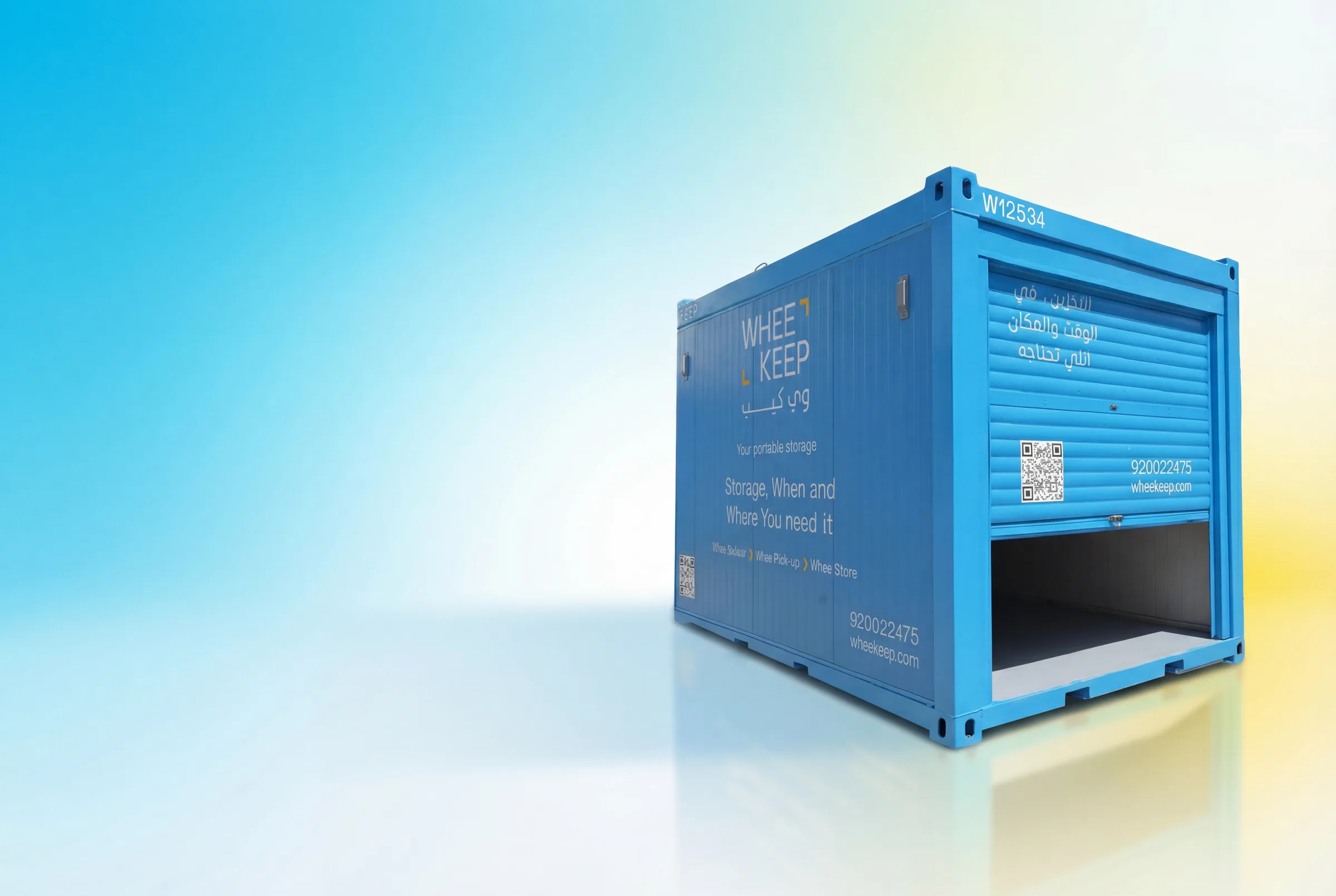
The first decision is unit size. At WheeKeep, three configurations cover the range most e-commerce sellers need:
- Small unit (2.4 × 1.5 × 2.35 m) at 599 SAR/month: Approximately 3.6 square metres of floor space with 8.5 cubic metres of volume. Well suited to sellers with a compact, high-value catalogue, think jewellery, accessories, small electronics, or personal care products. Enough room for several shelving units and a clear working lane.
- Medium unit (3.6 × 1.5 × 2.35 m) at 899 SAR/month: The most popular option. Around 5.4 square metres of floor space and 12.7 cubic metres of volume. Accommodates a full shelving system, a packing station, and a meaningful quantity of boxed inventory. The right choice for most growing e-commerce operations handling 200–800 orders per month.
- Large unit (3.6 × 2.4 × 2.5 m) at 1,289 SAR/month: Roughly 8.6 square metres and 21.6 cubic metres. Appropriate for sellers managing multiple product categories, bulky goods (sporting equipment, home furnishings, baby products), or those who use the space as a combined storage and light packing workspace.
A practical sizing rule: calculate your current stock volume in cubic metres, add 30% for incoming stock and packing materials, and select the unit size that covers that total without exceeding the large unit. If you regularly exceed large-unit capacity, a third-party logistics provider starts making more financial sense.
Setting Up the Unit for Efficient Fulfilment
The best-run self-storage units used for e-commerce share a few organisational features. First, vertical shelving maximises the full height of the unit rather than stacking boxes on the floor. Second, a dedicated packing zone, even just a folding table near the entrance, means orders can be prepped on-site rather than carrying stock home to pack. Third, a clear labelling and zone system, where fast-moving SKUs live near the door and slow-moving stock sits at the back, dramatically reduces the time spent per pick.
Many sellers also find it useful to maintain a simple Google Sheets stock ledger that maps each SKU to a specific shelf and row number within the unit. This is low-tech but highly effective and eliminates the need for expensive warehouse management software at early growth stages.
Access, Security, and Peace of Mind
WheeKeep units include a padlock and CCTV monitoring as standard, and on-demand return is built into the service model. For a seller accessing the unit daily or several times per week, the operating hours matter. WheeKeep's customer service is open 8 AM to 10 PM Sunday to Thursday and 9 AM to 10 PM on Saturday, and visits to your unit are by appointment.
Ready to move your inventory out of the spare room and into a professional space? WheeKeep's medium unit at 899 SAR/month is the most popular choice for growing e-commerce sellers in Riyadh and Jeddah. No long-term contract, cancel any time. Explore unit options and book online at WheeKeep.com.
Location Strategy: Matching Your Storage Unit to Your Fulfilment Flow
Location is one of the most underappreciated variables in e-commerce storage decisions. A unit that is too far from your home, your packing materials supplier, or a reliable last-mile courier drop-off point adds daily friction that compounds into hours lost each week.
WheeKeep Jeddah Hub
WheeKeep's Jeddah facility in An Nahda sits within reach of the city's main commercial districts and the residential density of central and northern Jeddah. For sellers dispatching through SMSA, Zajil, or AJEX pick-up points, Jeddah's urban grid makes this location practical for same-day handover to couriers. Jeddah is also the entry point for a significant volume of imported goods arriving through Jeddah Islamic Port, Saudi Arabia's busiest seaport, so sellers whose stock arrives by sea can reduce the distance between customs clearance and storage.
WheeKeep Asfan
The Asfan facility (21.808103739333482, 39.43077899716639) serves sellers based in the outer Jeddah metropolitan area and the Makkah corridor. For businesses whose customer base extends into the holy city and surrounding areas, particularly during Ramadan and Hajj season when demand for certain product categories spikes significantly, proximity to this corridor is a genuine logistical advantage. Sellers supplying pilgrimage-related goods or household essentials to the Makkah market will find this location reduces their delivery radius considerably.
WheeKeep Riyadh
WheeKeep's Riyadh facility in Tuwaiq serves sellers across the capital. Riyadh is Saudi Arabia's largest consumer market and the primary logistics hub for the central and northern regions. Sellers targeting customers in Riyadh's residential expansions, including the ROSHN-developed communities and the rapidly growing western suburbs, will find this location well positioned within the city's delivery network.
WheeKeep Boulevard Hub (Riyadh)
A practical location decision framework for e-commerce sellers: identify where the majority of your Riyadh or Jeddah orders are being delivered, map the nearest WheeKeep facility, and calculate the driving time from that facility to your primary courier drop-off or pick-up point. The goal is a triangle with short sides: home or office, storage unit, courier handover point. With one facility in each city and the unit delivered to you, WheeKeep keeps that triangle short for sellers in both cities.
Warehouse Storage vs Self-Storage: A Framework for Saudi E-Commerce Sellers
The decision between warehouse storage in Saudi Arabia and self-storage is not purely about cost. It involves operational complexity, growth stage, catalogue characteristics, and how much of the fulfilment process you want to manage yourself. Here is a structured framework for making that decision clearly.
The Fulfilment Ownership Question
The fundamental difference between a self-storage unit and a third-party warehouse is ownership of the fulfilment process. In a self-storage arrangement, the seller manages all picking, packing, and dispatch personally. In a 3PL warehouse arrangement, the provider handles those steps, typically for a per-order fee on top of the storage cost.
For sellers under approximately 30–50 orders per day, self-management is almost always more cost-effective. The economics only shift in favour of a 3PL when the time cost of personal fulfilment, combined with the per-order handling fees, starts to become favourable compared to the seller's opportunity cost. Most Saudi e-commerce sellers at the growth stage where this question becomes relevant are still well within the self-managed range.
The SKU Complexity Question
A seller with 10 SKUs and high volume is a different operational profile from a seller with 400 SKUs and moderate volume. High SKU count favours organised self-storage with a strong labelling system. Low SKU count with very high volume (hundreds of orders per day) starts to favour 3PL because the repetitive pick-pack-ship process becomes more efficiently delegated.
The Seasonality Question
Saudi retail has pronounced seasonal peaks: White Friday, Eid Al-Fitr, Eid Al-Adha, the Saudi National Day period in late September, and Ramadan (when consumption patterns shift significantly toward online orders placed late at night). A self-storage unit with no minimum contract term allows a seller to take a larger unit for three months ahead of peak season and downgrade afterward. A warehouse lease locks you into a fixed cost regardless of how demand moves.
This flexibility is not trivial. A seller paying 1,289 SAR/month for a large unit during the October–January peak and 599 SAR/month for a small unit during quieter months saves over 8,000 SAR annually compared to holding the large unit year-round, and far more compared to a warehouse lease sized for peak capacity.
The Growth Trajectory Question
If your business is growing and your storage needs are changing every few months, locking into a 12-month warehouse lease is a significant risk. Self-storage with flexible terms lets the storage arrangement grow alongside the business without penalty. When the business reaches a scale where a dedicated warehouse genuinely makes economic and operational sense, that transition can be made from a position of strength rather than urgency.
Affordable Storage Units in Saudi Arabia: What "Affordable" Really Means for E-Commerce
The word "affordable" is relative. For e-commerce, the correct metric is not the absolute monthly cost of storage but the cost of storage as a percentage of revenue, and the contribution of good storage to reducing operational waste and increasing order accuracy.
Consider a seller generating 80,000 SAR per month in gross revenue. A medium WheeKeep unit at 899 SAR/month represents just over 1% of revenue. For that 1%, the seller receives:
- A dedicated, climate-controlled space protecting stock from Saudi summer heat damage
- A professional environment that eliminates the domestic disruption of home-based storage
- CCTV security and a padlock system protecting stock that may represent 20,000–40,000 SAR in inventory value
- Flexible access during operating hours seven days a week (except Friday)
- No long-term commitment, allowing the seller to scale up or cancel based on business conditions
- On-demand return of stored items as operational needs change
Viewed through that lens, affordable storage units in Saudi Arabia are not about finding the cheapest possible option. They are about finding the option that delivers the best return on the storage investment relative to the operational value it provides. A seller who loses 3,000 SAR of stock to heat damage in a single summer month has paid more than three months of WheeKeep's small unit fee for the privilege of "free" home storage.
The Hidden Costs of Not Storing Properly
Beyond direct stock damage, poorly organised inventory creates a cascade of indirect costs that are easy to undercount:
- Fulfilment errors: Disorganised stock leads to wrong items being shipped. Each return costs the seller in reverse logistics, customer service time, and potential negative reviews on Noon or Amazon.sa, where seller ratings directly affect visibility.
- Time cost: A seller spending 90 minutes per day navigating a chaotic storage arrangement is effectively paying a significant hourly labour cost to maintain disorder. Organised storage typically reduces daily pick time by 30–50% for comparable order volumes.
- Domestic quality of life: This is rarely quantified but genuinely matters. Running a business from a living space that has been taken over by inventory creates stress, reduces household harmony, and in many Saudi households, creates practical problems around guest reception and family space, which carries real cultural significance.
- Scalability ceiling: A seller who cannot take on a new supplier relationship because they have no space for the incoming stock is capping their own growth. The opportunity cost of passed-over inventory opportunities can be substantial.
Storage Solutions for Small Businesses in Saudi Arabia: The Broader Picture
Storage solutions for small businesses in Saudi Arabia extend well beyond the immediate inventory challenge. A self-storage unit, used thoughtfully, becomes a multifunctional business asset that serves several operational purposes simultaneously.
Document and Equipment Archiving
Saudi businesses are required to retain certain records and documents under ZATCA (Zakat, Tax and Customs Authority) regulations. E-commerce sellers registered for VAT at the 15% rate applicable in the Kingdom need to maintain invoices, customs documents, and financial records for defined retention periods. Saudi VAT is 15%, set by the Zakat, Tax and Customs Authority (ZATCA). A self-storage unit provides a secure, organised archive space that keeps business records out of the home without requiring a dedicated office.
Equipment and Packaging Materials Storage
Serious e-commerce operations accumulate more than inventory. Packaging materials, bubble wrap, tape dispensers, label printers, scales, and packing tables all need a home. A medium or large WheeKeep unit provides enough space to store packaging supplies in bulk (which reduces per-unit packaging cost through volume purchasing) while keeping them clean, dry, and accessible.
Returns Processing
Return rates on Saudi e-commerce platforms vary by category but are a consistent operational reality. Having a dedicated section of a storage unit for returned goods, awaiting inspection, repackaging, or supplier return, creates a clean separation between sellable stock and returns inventory. This separation is basic but surprisingly impactful: sellers who mix returns with clean stock create downstream quality problems that are far more costly than the space required to keep them apart.
Seasonal Stock Rotation
Many Saudi e-commerce sellers carry seasonal lines: Ramadan decorations and prayer accessories, Eid gifting sets, back-to-school supplies, and National Day merchandise. A self-storage unit allows a seller to hold off-season stock professionally until it is needed again, rather than liquidating at a loss simply because there is no room for it at home between seasons.
Navigating Saudi Arabia's Logistics Infrastructure as an E-Commerce Seller
Storage does not exist in isolation. It sits within a broader logistics chain that, for Saudi e-commerce sellers, has specific characteristics and constraints worth understanding.
Last-Mile Delivery Partners
The dominant last-mile providers serving Saudi e-commerce sellers include SMSA Express, Zajil Express, and AJEX. Each operates differently in terms of pick-up scheduling, coverage maps, and per-shipment pricing. Sellers using a self-storage unit rather than home-based fulfilment need to confirm that their chosen courier can schedule pick-ups from their storage facility address, or that a drop-off point is conveniently nearby. WheeKeep's facilities in Jeddah and Riyadh are located within urban areas where courier coverage is comprehensive.
Customs and Import Considerations
Sellers importing goods through Jeddah Islamic Port or King Abdulaziz Port in Dammam need to factor in the time between customs clearance and stock availability for fulfilment. Having a WheeKeep unit close to the import corridor, in Jeddah near the port's commercial zone, means goods can move from customs to storage to fulfilment with minimum additional handling. The Saudi Customs Authority under ZATCA manages import duties and VAT on imports, and sellers should ensure their import documentation is aligned with their registered business address and storage location for compliance purposes.
Ramadan and Peak Season Logistics
Ramadan creates a specific operational challenge for Saudi e-commerce sellers. Consumer behaviour shifts toward late-night purchasing, with order volumes spiking significantly after Iftar and into the early morning hours. Courier and logistics provider schedules often adjust during Ramadan, with some services operating on compressed daytime windows. Sellers who pre-position adequate stock in a well-organised storage unit before Ramadan begins are better placed to absorb the volume spike without fulfilment delays. This is a concrete use case where having a medium or large WheeKeep unit with organised shelving makes a measurable difference to order turnaround time during the Kingdom's highest-stakes retail period.
A Decision Framework for Choosing Your Storage Setup
Not every e-commerce seller in Saudi Arabia is at the same stage. The right storage decision depends on where you are in the business lifecycle. Use this framework to identify your current stage and the recommended storage approach.
| Business Stage | Monthly Revenue (SAR) | Orders/Day | Recommended Storage | WheeKeep Unit |
|---|---|---|---|---|
| Testing / Pre-Revenue | 0–5,000 | 0–5 | Home storage acceptable | Not yet required |
| Early Growth | 5,000–30,000 | 5–20 | Self-storage (small unit) | Small, 599 SAR/mo |
| Established Growth | 30,000–150,000 | 20–80 | Self-storage (medium unit) | Medium, 899 SAR/mo |
| Scaling | 150,000–400,000 | 80–200 | Self-storage (large unit) or evaluate 3PL | Large, 1,289 SAR/mo |
| High Volume | 400,000+ | 200+ | Dedicated warehouse or 3PL | Multiple units as overflow |
This framework is a starting point, not a rigid rule. A seller with 200 SKUs and 30,000 SAR/month revenue may genuinely need a medium unit based on catalogue complexity alone. Conversely, a seller with 50,000 SAR/month but only 8 SKUs may manage comfortably with a small unit and excellent organisation. Use the framework to orient your thinking, then adjust based on your specific catalogue and fulfilment pattern.
Practical Tips for Running an E-Commerce Operation from a Self-Storage Unit
Getting the most from a self-storage unit as an e-commerce workspace requires a slightly different mindset from simply "putting boxes in a room." The sellers who find it most effective treat the unit as a professional mini-warehouse, not a larger version of their garage.
Invest in Shelving from Day One
Heavy-duty metal shelving units are available from Jarir, IKEA, or industrial suppliers in Riyadh's Batha district or Jeddah's Hamra area for 200–600 SAR per unit. Three shelving units running the length of a medium WheeKeep unit, positioned against the walls with a central working corridor, will transform the usable capacity of the space. Floor stacking is wasteful and dangerous; a single toppled stack can damage hundreds of SAR of inventory in seconds.
Label Everything with a Consistent System
A simple alphanumeric labelling system (Shelf A1, A2, B1, B2, etc.) combined with a matching spreadsheet or basic inventory app takes two hours to set up and saves significant time every single day. Label each shelf position, each product category zone, and each bin. Print your labels rather than handwriting them; they last longer and are easier to read under storage unit lighting conditions.
Use the Vertical Space
WheeKeep's units have ceiling heights of 2.35–2.5 metres depending on the unit size. Shelving that reaches to 2.0–2.1 metres doubles your usable storage volume compared to standard-height shelving. For lighter items (packaging materials, soft goods, accessories), upper shelf positions work well. Reserve lower, accessible positions for fast-moving SKUs that you pick multiple times per day.
Create a Dedicated Packing Zone
A folding table positioned near the unit entrance, with a small shelf above it holding tape, labels, a printer, and packing materials, creates a functional packing station within the unit itself. This means you can pick, pack, and seal orders entirely within the storage unit rather than carrying loose items to and from a vehicle. For sellers handling 20–50 orders per visit, this single change reduces visit time by 30–40%.
Manage Your Visit Schedule Like a Business
Rather than visiting the unit reactively (going in to pick a single order whenever it comes in), batch your fulfilment visits. This reduces fuel cost, reduces time in transit, and allows you to align pick runs with courier collection windows. WheeKeep's operating hours accommodate morning and evening fulfilment runs comfortably.
Keep a Reorder Trigger System
The most common stock management failure in self-storage-based e-commerce is running out of a key SKU because there was no visibility of depletion. Set a physical reorder trigger: a brightly coloured card or a distinctively marked "reorder box" placed at a specific shelf position. When you hit the reorder box, you know it is time to place a replenishment order. This low-tech system prevents stockouts without requiring any software investment.
Frequently Asked Questions About E-Commerce Storage in Saudi Arabia
Can I use a self-storage unit as a registered business address in Saudi Arabia?
No. Self-storage units are not suitable as a registered commercial address for Ministry of Commerce (MoC) registration purposes. They serve as a physical storage and operational space for inventory and equipment, but your business must maintain a separate registered address. Many small e-commerce sellers use a home address or a business centre address for registration while using a WheeKeep unit for their actual inventory operations.
Is climate control important for all types of e-commerce inventory?
Climate control is critical in Saudi Arabia given the extreme summer temperatures. Products particularly sensitive to heat include electronics, batteries, cosmetics, skincare, chocolates and confectionery, candles, certain apparel fabrics, and anything with adhesive components. Even products considered "stable" can suffer packaging degradation, label adhesive failure, or colour fading when stored at 40°C+ for extended periods. WheeKeep units are climate-controlled, which protects your stock through the May-September heat peak.
How do I handle courier pick-ups from a self-storage unit?
Most major Saudi last-mile couriers including SMSA, Zajil, and AJEX offer pick-up scheduling from any address within their service area, which includes the urban locations where WheeKeep operates. Contact your courier provider to confirm pick-up availability at your specific WheeKeep facility address. Alternatively, you can schedule drop-offs at nearby courier service points, which are widely distributed in both Jeddah and Riyadh commercial areas.
What size unit do most e-commerce sellers start with?
The Medium unit (3.6 × 1.5 × 2.35 m at 899 SAR a month) is a practical starting point for e-commerce sellers because it provides enough room for a meaningful stock holding and packaging materials without overcommitting on cost. Sellers with very compact product catalogues (jewellery, small accessories, digital accessories) often find the small unit at 599 SAR/month sufficient for the first stage of growth.
Can I upgrade to a larger unit if my business grows?
Yes. WheeKeep's flexible, no-long-term-contract model allows you to move between unit sizes as your storage needs change. This is one of the key advantages over a traditional warehouse lease, where you are committed to a fixed space regardless of how your business evolves. Sellers approaching peak season can upgrade to a larger unit for the peak months and return to a smaller unit afterward.
Is it safe to store high-value inventory in a self-storage unit?
WheeKeep units include CCTV monitoring and padlock security as standard. For high-value inventory, sellers should also consider appropriate business insurance coverage for goods held off-premises. Consult with a Saudi insurance provider about stock-in-storage coverage. The security environment in a professionally managed self-storage facility is substantially superior to a domestic garage or home storeroom.
Are there any restrictions on what I can store in a WheeKeep unit?
Standard self-storage restrictions apply: hazardous materials, flammable goods, perishable food items, and any items prohibited under Saudi law cannot be stored. For the vast majority of e-commerce product categories (clothing, electronics, home goods, cosmetics, toys, accessories, books, sporting goods), there are no restrictions. If you have a specific product category question, contact WheeKeep directly to confirm suitability before renting.
How does self-storage for e-commerce compare to using a fulfilment centre like Amazon FBA?
Amazon FBA (Fulfilment by Amazon) on Amazon.sa handles storage, picking, packing, and shipping on your behalf but charges per-unit storage fees and per-order fulfilment fees that accumulate quickly for slower-moving inventory. Self-storage gives you full control over your inventory at a flat monthly cost, which is typically more economical for sellers with diverse catalogues or products that do not turn over rapidly. Many successful Saudi sellers use a hybrid model: FBA for fast-moving, standardised products and self-storage for the broader catalogue, seasonal lines, and returns inventory.
What happens if I need to access my unit outside of WheeKeep's operating hours?
WheeKeep's customer service is open 8 AM to 10 PM Sunday to Thursday and 9 AM to 10 PM on Saturday, and visits to your unit are by appointment. The facility is closed on Fridays. For urgent access needs, contact WheeKeep directly to discuss your specific operational requirements.
Do I need to provide my own shelving and equipment?
Yes. WheeKeep units are clean, empty spaces that you configure to your own needs. This is actually an advantage: you can set up the unit exactly as your fulfilment workflow requires rather than adapting to a fixed layout. Heavy-duty metal shelving, folding tables, and label systems are inexpensive investments that dramatically increase the functional value of the unit for e-commerce purposes.
Is self-storage suitable for a seller who also runs a physical retail stall?
Absolutely. Many sellers in Saudi Arabia operate across both online and offline channels, maintaining a presence on digital platforms while also attending weekend markets, pop-up events, or operating a small retail counter. A self-storage unit serves as the central inventory hub for both channels, allowing stock to be allocated between online fulfilment and retail replenishment from a single organised location.
What is the minimum rental period for a WheeKeep unit?
WheeKeep operates on a flexible, no-long-term-contract basis. There is no enforced minimum term, and you can cancel at any time. This is a fundamental advantage for e-commerce sellers whose storage needs fluctuate with seasonal demand, product launches, and business growth stages.
Key Takeaways
- E-commerce storage in Saudi Arabia sits in a gap between inadequate home storage and prohibitively expensive traditional warehousing. Self-storage units fill that gap effectively for growing sellers.
- Saudi summer heat (40–50°C from May to September) makes climate-controlled storage a genuine financial necessity, not a luxury. Stock damage from heat is a real and quantifiable risk for sellers using informal storage.
- WheeKeep's three unit sizes (599, 899, and 1,289 SAR/month) cover the full range of needs from early-growth to scaling operations, with no long-term contract commitment and the flexibility to change unit size as the business evolves.
- Location matters.
- The real cost of storage is not the monthly fee but the total cost including stock damage, fulfilment errors, lost time, and missed growth opportunities that flow from disorganised or inadequate storage arrangements.
- A medium WheeKeep unit at 899 SAR/month, configured with proper shelving, a packing station, and a simple labelling system, can support a seller processing 20–80 orders per day efficiently and professionally.
- Seasonal flexibility is a major strategic advantage. Saudi retail peaks (Ramadan, Eid, White Friday, National Day) create predictable demand spikes that flexible storage contracts accommodate cleanly.
- Self-storage and 3PL or FBA are not mutually exclusive. A hybrid model, using self-storage for the broader catalogue and platform fulfilment for fast-moving lines, is a practical and cost-effective approach for many Saudi sellers.
The seller who started this guide surrounded by boxes in a Jeddah spare bedroom has a clear path forward. It does not require a warehouse budget, a logistics team, or a long-term lease commitment. It requires a professional unit, a shelving system, and a consistent fulfilment routine. WheeKeep exists precisely to make that transition straightforward, affordable, and reversible at every stage of the journey.
Take the next step. WheeKeep has a facility in Jeddah and one in Riyadh, ready for e-commerce sellers who need better inventory storage. Units start from 599 SAR a month with no long-term contract, CCTV security and a free padlock, and an on-demand return costs 99 SAR before VAT, the round trip. Book your unit at WheeKeep.com today and move your business out of the spare room.