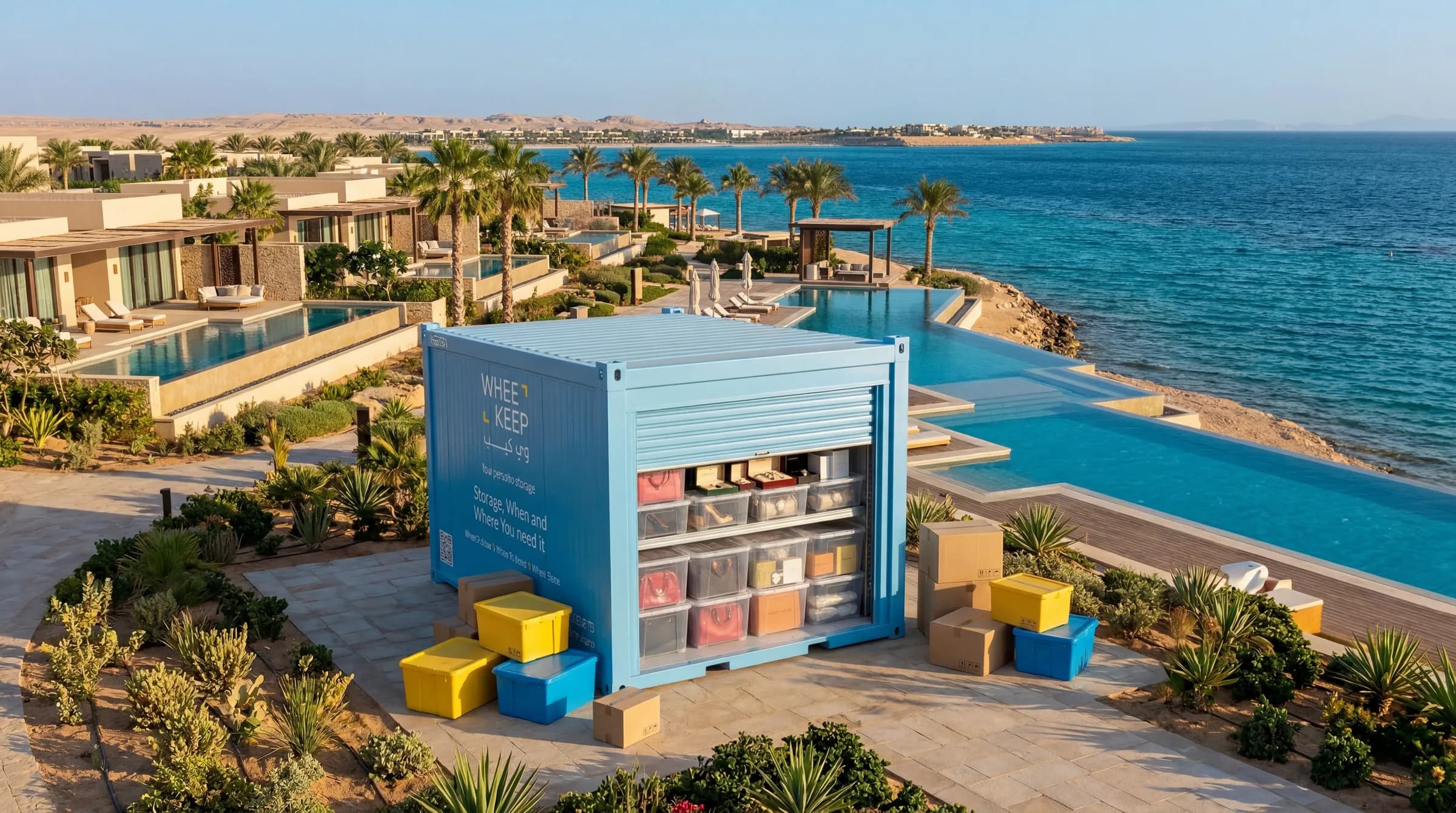
Expat Guide: Managing Your Belongings in Saudi Arabia
Moving to, within, or out of Saudi Arabia? This practical expat guide covers how WheeKeep's flexible storage units keep your belongings safe at every life stage.
Most expats arrive in Saudi Arabia with a plan for their furniture. Very few arrive with a plan for what happens to that furniture when the plan changes. And in the Kingdom, plans change constantly: a contract ends early, a project in NEOM runs long, a family member flies in from Lahore or Cairo and needs the spare room, a landlord in Riyadh decides not to renew. The average expatriate in Saudi Arabia moves residences more than twice during a single posting, according to patterns that anyone who has lived here for more than three years will recognise immediately.
The conventional approach to this problem is improvisation: stack boxes in a friend's villa, ship everything home at enormous cost, or sign a lease on a larger flat just to have somewhere to put things. None of these are good solutions. What actually works is having a flexible, accessible storage buffer that absorbs the friction between one chapter of expat life and the next. This guide walks through every major transition an expat faces in the Kingdom, and explains precisely how smart storage for expats in Saudi Arabia turns those friction points into smooth handovers.
1. The Arrival Gap: Why Your First Weeks in Saudi Arabia Are the Most Dangerous for Your Belongings
The arrival gap is the period between when you land in Saudi Arabia and when your permanent accommodation is ready. It is the single most common moment at which expats make expensive storage mistakes, yet it is almost never discussed in relocation guides.
Here is what typically happens. Your employer arranges a serviced apartment in Riyadh or Jeddah for two to four weeks while you find permanent housing. Your air freight arrives quickly. Your sea freight, which contains your furniture, appliances, and most of your household goods, arrives six to twelve weeks later. At that point, your permanent flat may still be in negotiation, the previous tenant may not have vacated, or your villa in a compound in Al Nakheel or Hatten may still be undergoing maintenance. Your container sits at Jeddah Islamic Port or King Abdulaziz Port in Dammam, accruing demurrage charges at a rate that will genuinely surprise you.
The financially intelligent move is to clear customs immediately and move goods into a storage unit rather than leaving them at the port. WheeKeep's Jeddah facility in An Nahda is practical for freight cleared through Jeddah's port, and the Riyadh facility in Tuwaiq receives goods trucked in from the ports. A medium storage unit at 899 SAR per month is almost always cheaper than a single week of port demurrage on a full container.
What to Store During the Arrival Gap
- Furniture and white goods that cannot go into a serviced apartment
- Seasonal clothing you will not need during the Saudi summer (if arriving May–September)
- Sports and hobby equipment that is impractical in temporary accommodation
- Children's bicycles, outdoor toys, and garden furniture
- Books, art, and fragile items that should not be moved twice unnecessarily
The practical approach: book your unit before your sea freight clears. WheeKeep's customer service is open 8 AM to 10 PM Sunday to Thursday and 9 AM to 10 PM on Saturday, and visits to your unit are by appointment. Units come with a padlock and continuous CCTV monitoring, so your goods are protected from the moment they arrive.
2. Between Leases: Navigating the Most Stressful Storage Moment in Expat Life
The between-leases gap is the storage challenge most expats in Saudi Arabia face repeatedly, and it is more complicated here than in most countries. Saudi tenancy law, combined with the dynamics of the expat housing market in cities like Riyadh and Jeddah, creates a situation where lease end dates and new lease start dates rarely align cleanly.
Several factors make this worse than it sounds. Many landlords in Riyadh's northern districts (Al Malqa, Al Aqiq, Hittin) and Jeddah's expat-heavy areas (Al Rawdah, Al Zahraa, Al Hamra) operate on Hijri calendar lease cycles, which means your Gregorian end date shifts slightly each year. Compound leases, common for Western and Asian expat families, often require ninety days' notice but only offer thirty-day grace periods for handover. When your new compound flat is not ready and your old one must be vacated, you face a gap that can range from five days to six weeks.
The common approach is to put everything into the new flat's garage or a storage room within the compound. This creates several problems: compound storage rooms are frequently unsecured, humidity in Jeddah (which sits on the Red Sea coast and experiences year-round high humidity) causes mould and warping in unventilated spaces, and you lose access to your goods the moment the compound gates close at night.
A flexible storage rental in Saudi Arabia solves this structurally. You book a unit for the exact duration of the gap, pay by the month with no long-term contract, and cancel when your new place is ready. WheeKeep's pricing structure is designed for exactly this scenario:
| Unit Size | Dimensions | Monthly Rate | Best For |
|---|---|---|---|
| Small | 2.4 × 1.5 × 2.35 m | 599 SAR/mo | Single professional, short gaps, boxes and personal items |
| Medium | 3.6 × 1.5 × 2.35 m | 899 SAR/mo | Couples or small families, 1–2 bedroom apartment contents |
| Large | 3.6 × 2.4 × 2.5 m | 1,289 SAR/mo | Families, 3-bedroom home contents, large items |
No long-term contract means you can cancel when the gap closes. On-demand return means if you suddenly need your sofa or your children's school supplies, WheeKeep brings them to you. That combination of flexibility and access is what makes moving storage solutions in Saudi Arabia genuinely useful rather than just another logistical layer.
3. The Home Renovation Trap: Why Saudi Renovation Timelines Demand a Storage Contingency
Saudi Arabia's construction and renovation sector is experiencing a sustained boom driven by Vision 2030's residential development goals and an expanding middle class. Projects like ROSHN's new residential communities across Riyadh, Jeddah, and Dammam are delivering thousands of new homes, and existing homeowners are renovating to match new market expectations. The result is a renovation sector that is busy, often stretched, and chronically unable to deliver on its original timelines.
If you are an expat who owns property in the Kingdom, or a long-term resident undertaking a major renovation, the timeline problem is compounded by the difficulty of sourcing materials. A kitchen renovation in a Riyadh villa that would take three weeks in London or Dubai can run six to ten weeks in Saudi Arabia if a specific tile or fitting needs to be sourced from Dammam or imported through Jeddah. During that time, you need somewhere to put your furniture that is not your living room floor.
The trap most homeowners fall into is moving furniture room by room as the renovation progresses. This seems logical but creates two problems. First, you are constantly disrupting your workflow because you are living in a construction zone with furniture constantly in the way. Second, dust and debris from renovation work in Saudi Arabia (particularly the fine-particle desert dust that penetrates everything) will damage upholstery, electronics, and wooden furniture that remains in the property.
How to Apply This in Practice
Move everything out before the renovation starts. Book a large storage unit for moving in Saudi Arabia for the projected duration of the project, plus a two-week buffer. Store all furniture, rugs, artwork, electronics, and fragile items. Live in a serviced apartment or with family for the duration. When the renovation is complete and the dust has been professionally cleaned, return your goods from storage in a single organised move.
This approach is not just more comfortable. It is faster, because contractors can work without navigating around your furniture, and it results in better outcomes because items are not damaged by construction dust. WheeKeep's on-demand return service means that if a room finishes earlier than expected, you can retrieve those items immediately rather than waiting for a full delivery window.
4. Managing a Job Transfer Across Saudi Cities: Storage as a Career Tool
Saudi Arabia's Vision 2030 transformation is reshaping where economic activity happens. Riyadh is becoming a global business hub, with the Royal Commission for Riyadh City overseeing a massive infrastructure expansion. NEOM is attracting thousands of engineers, planners, and project managers to the Tabuk region. The Red Sea Project is bringing hospitality professionals to the coast. Qiddiya is drawing entertainment and events talent south of Riyadh. Diriyah Gate is creating a permanent heritage and cultural sector. AlUla is building an arts and archaeology economy from scratch.
The practical consequence for expats is that intra-Kingdom job transfers are increasingly common, and they create a storage problem that is structurally different from international relocation. When you move from Riyadh to Jeddah, or from Jeddah to NEOM, you often do not know how long the new posting will last. You may be on a project contract of twelve to eighteen months. You may want to keep a base in Riyadh while working in Tabuk. You almost certainly cannot afford to ship your entire household to a location that may not work out.
The solution that works in practice is a split-storage strategy. You take the essentials to your new location, furnished or semi-furnished. You store everything else at a WheeKeep facility near your home city. Your goods are safe, climate is not a concern because WheeKeep facilities are maintained environments, and you can retrieve specific items as your new accommodation situation clarifies.
The Split-Storage Framework for Intra-Kingdom Transfers
- Inventory your household and categorise items as "essential for the new posting" versus "store for now"
- Book a storage unit in your departure city before you leave, not after, units at popular locations fill up, particularly in Riyadh's northern districts
- Move essentials to temporary or furnished accommodation in your new city first
- Assess the new posting after ninety days: if it looks permanent, retrieve stored goods and set up properly; if still uncertain, maintain the storage arrangement
- Cancel the unit with no penalty when you are confident in the new situation
WheeKeep's Riyadh facility in Tuwaiq serves Riyadh-based professionals making transfers. WheeKeep's Jeddah facility in An Nahda serves those moving out of or through Jeddah.
5. End-of-Contract Departure Planning: The Storage Window That Most Expats Miss
When an expat's contract ends in Saudi Arabia, the administrative workload is formidable. Exit visas, final settlements, shipping arrangements, school deregistration for children, IQAMA cancellation, GOSI claims, bank account closures, the list is long and the timeline is typically short. Most companies give thirty to sixty days from contract termination to departure, and during that window the expat is simultaneously still working (often on handover) and trying to organise an international move.
The storage gap here is specific and often overlooked. Your shipping company will come to pack and collect your goods on a specific date. Your lease ends on a different date. Your flight is on a third date. These three dates almost never align, and the gaps between them create a situation where you have vacated your property, your goods have not yet been collected, and you have nowhere to keep them safely.
This is particularly acute for expats in Jeddah's expat compounds and Riyadh's diplomatic quarter, where compound management expects full property handover by a firm date. There is no grace period, no friendly landlord who will let you leave a few boxes in the garage. You need a solution that bridges the gap between property handover and shipping collection, and that solution is a short-term storage unit.
The End-of-Contract Storage Timeline
| Week | Action | Storage Role |
|---|---|---|
| Weeks 1–2 | Confirm departure date, notify landlord, book shipping company survey | Book WheeKeep unit as contingency |
| Weeks 3–4 | Begin sorting, items to ship, items to sell, items to donate, items to store temporarily | Move items not going in the container to storage |
| Weeks 5–6 | Shipping company packs and collects; property handover to landlord | Remaining items in storage unit; property fully vacated |
| Weeks 7–8 | Final administrative tasks, IQAMA cancellation, departure | Storage unit cancelled; items retrieved or forwarded |
For expats who are uncertain whether they will return to Saudi Arabia (perhaps the contract is ending but a renewal is possible), WheeKeep's no-long-term-contract model is ideal. You can store your furniture, keep your options open, and if the renewal comes through, retrieve everything without the cost and complexity of re-shipping from abroad.
If you are currently navigating a lease transition, job transfer, or departure in Saudi Arabia, WheeKeep has units available in Riyadh and Jeddah from 599 SAR per month, with no long-term commitment and on-demand return of your goods. Check availability and book your unit now.
6. Family Reunification and the Furniture Problem Nobody Talks About
A specific pattern in Saudi expat life involves family reunification: the professional arrives alone, establishes themselves, and then brings a spouse and children. This transition is common across all expat nationalities but is particularly frequent among South Asian, Southeast Asian, and Arab expat communities in the Kingdom. The Jeddah and Dammam expat populations in particular include large numbers of professionals who have been living in shared bachelor accommodation and now need to transition to family accommodation rapidly.
The furniture problem here is real and underappreciated. The professional may have accumulated personal goods over months or years of solo living: a good mattress, kitchen equipment, a television, books, gym equipment. The family arrives with their own goods from home, including children's furniture, toys, educational materials, and household items accumulated over years. The new family apartment is often not large enough to absorb both sets of belongings immediately.
The practical solution is not to have a clear-out in the first week, which is stressful and often results in discarding items you later regret losing. The better approach is to move the overflow into storage, live in the family apartment for thirty to sixty days, identify what you actually use and need, and then dispose of the surplus thoughtfully while knowing your stored items are safe and accessible.
What to Store During Family Reunification
- Duplicate furniture (two dining tables, two sets of sofas) until you decide which to keep
- Children's items from the home country that need to be assessed against Saudi school and activity requirements
- Seasonal items (heavy clothing, winter bedding) that are not needed in Saudi Arabia's climate but will be needed when visiting home
- Hobby and sporting equipment that does not fit in the new flat but will be needed once you establish a routine
- Business items if the professional has home-office equipment that the family flat cannot accommodate
A small unit at 599 SAR per month handles this transition comfortably for most single-to-family conversions. The no-contract model means you are not committed for longer than you need.
7. Self Storage in Riyadh for Business-Using Expats: The Overlooked Advantage
A growing segment of the Saudi expat population is not purely employed, they are entrepreneurs, freelancers, e-commerce operators, and small business owners operating under the Kingdom's expanding business ownership frameworks. The Ministry of Investment (MISA) has made it significantly easier for foreign nationals to establish businesses in Saudi Arabia under Vision 2030, and the result is a growing cohort of expat business owners who have both personal and commercial storage needs.
For this group, self storage in Riyadh and Jeddah serves a dual purpose. On the personal side, the same transition-management logic applies as for all expats. On the business side, storage units serve as a cost-effective alternative to formal warehousing for small inventory, sample stock, marketing materials, event equipment, and seasonal goods.
The economics are compelling. A formal warehousing arrangement in Riyadh's industrial zones typically requires a minimum lease of six to twelve months, a commercial registration at that address, and a much higher monthly cost than a storage unit. Consumer rights and commercial registrations are overseen by the Ministry of Commerce. For an early-stage e-commerce business selling on Noon or Amazon.sa, or a consultant who needs secure storage for demonstration equipment, a WheeKeep large unit at 1,289 SAR per month is a practical and flexible bridge until the business justifies dedicated warehousing.
Business Use Cases That Work Well in Self Storage
| Business Type | What Gets Stored | Recommended Unit | Notes |
|---|---|---|---|
| E-commerce (fashion, homewares) | Inventory, packaging, returns | Medium or Large | ✅ No commercial lease required |
| Events and exhibition consultancy | Display materials, signage, AV equipment | Large | ✅ Access between events |
| Interior design / fit-out | Sample materials, fixtures, tools | Medium | ⚠️ Organise by project for easy retrieval |
| Consulting / training | Training materials, laptops, projectors | Small | ✅ CCTV provides security for electronics |
| Food and beverage (dry goods) | Packaged non-perishables, smallwares | Medium or Large | ❌ Not suitable for refrigerated goods |
8. Ramadan and Seasonal Transitions: Storage Patterns Unique to Saudi Arabia
Saudi Arabia has seasonal patterns that are unlike any other expat destination in the world, and they create storage demands that are genuinely unique. Understanding these patterns is part of what distinguishes an expat who manages their belongings well from one who is constantly improvising.
The most significant seasonal event is Ramadan, typically falling in the ninth month of the Hijri calendar. During Ramadan, many expat families travel home for extended periods, sometimes the entire month. Their accommodation in Riyadh or Jeddah sits empty. If the accommodation is a compound villa rather than a long-term apartment, there may be pressure from compound management to make the property available during extended absences. Even if the property is secure, leaving an entire household of goods in a villa that nobody visits for four weeks in the Saudi summer heat (temperatures in Riyadh can exceed 45°C in June and July) creates real risks for certain categories of goods. Temperature and humidity records for Saudi cities are published by the National Center for Meteorology.
The summer migration is equally significant. Families with children often spend the entire school summer holiday abroad, two to three months in their home country. Expat professionals in construction and petrochemical sectors frequently take their main annual leave in July and August. For families in villa accommodation in Riyadh's northern suburbs (Al Yasmin, Al Narjis, Al Arid) or Jeddah's coastal areas, leaving a fully furnished property empty for this long creates both security and maintenance concerns.
What to Consider Storing During Extended Absences
- High-value electronics and collectibles that you would not want left unmonitored for months
- Important documents and valuables (though a bank safe deposit box is better for the most sensitive items)
- Seasonal clothing from home that has no use in a Saudi summer but takes up space in your wardrobe
- Musical instruments and specialist hobby equipment that can be damaged by temperature extremes in an unoccupied property
- Camping and outdoor gear accumulated for use in Saudi Arabia's spectacular winter hiking season in Asir, Taif, or AlUla, stored during the summer and retrieved for the October–March outdoor season
The Hajj and Umrah seasons create additional storage demand around Mecca and Medina. For expats living and working in these cities, or for those facilitating pilgrim services under the Ministry of Hajj and Umrah's approved operator frameworks, short-term storage for equipment, promotional materials, and operational goods is a recurring need that WheeKeep's flexible model accommodates well.
9. Downsizing Without Losing: How to Right-Size Your Saudi Home Without Discarding Things You Will Regret
Downsizing is one of the most emotionally and logistically complex transitions an expat undertakes. It typically happens for one of three reasons in Saudi Arabia: a contract change that reduces the employer's accommodation allowance, a deliberate lifestyle choice to move from a large compound villa to a smaller city apartment, or a family change (children leaving for university abroad) that reduces the space requirement.
The common approach is to hold a massive clear-out: sell furniture on Facebook Marketplace groups (active in Riyadh and Jeddah expat communities), donate to local charities, or simply discard. This approach has a predictable outcome, within six months, you regret specific decisions. The dining table you sold for 400 SAR cost 3,000 SAR to replace. The children's bedroom furniture that went to charity was needed when the children came home for summer. The garden furniture you left on the street is now being sold in a second-hand shop in Al Suwaidi for twice what you would have accepted.
The more considered approach uses storage as a decision buffer. Move to the smaller property. Put everything that does not fit into storage for sixty to ninety days. Live in the new space and identify precisely what you miss. Then make permanent disposal decisions from a position of knowledge rather than urgency. You will almost certainly end up discarding less than you would have in the heat of the move, and the items you do keep will be the right ones.
The Three-Box Method for Expat Downsizing in Saudi Arabia
- Keep (immediate): Items you know you need in the new, smaller space from day one
- Store (decision pending): Items you are unsure about, these go to WheeKeep for a defined trial period
- Release (permanent): Items you are certain you will not need, sold, donated, or disposed of before the move
The key discipline is putting a time limit on the "Store" category. Commit to making a final decision on stored items within ninety days. When you visit your unit to retrieve something you have missed, that is evidence to keep it. When you realise you have not thought about an item since the day you stored it, that is evidence to release it.
10. Returning Expats: Using Storage to Keep Your Saudi Options Open
A significant and growing segment of the Saudi expat population is not leaving permanently, they are leaving temporarily. Contract-to-contract transitions, family circumstances, medical leave, or a posting to another country before returning to the Kingdom all create situations where an expat departs Saudi Arabia without certainty about whether, or when, they will return.
This is where moving storage solutions in Saudi Arabia offer a genuinely strategic advantage. Shipping your entire household internationally is expensive (a full container from Jeddah to the UK or India costs several thousand SAR in freight alone, plus insurance and customs duties at the destination). Selling everything before departure and re-buying on return is even more expensive in aggregate, and it destroys the continuity of your household.
The middle path is partial international shipping combined with local storage. You ship the items that are genuinely irreplaceable or that you know you will need immediately at the destination. You store the items that are practical and valuable in Saudi Arabia but impractical to ship, large furniture, appliances, outdoor goods, children's seasonal items. When you return, your household foundation is waiting for you. You retrieve your stored goods, supplement with the items you shipped back, and re-establish your Saudi home in days rather than weeks.
The Financial Case for Storage Over Full Shipping
Consider a family departing Riyadh for a twelve-month gap year before returning. Full container shipping to Europe and back costs approximately 15,000–25,000 SAR in freight, plus import duties at both ends, plus the cost of temporary storage in the destination country. Storing the bulk of the household at WheeKeep in Riyadh for twelve months at the large unit rate costs 1,289 SAR × 12 = 15,468 SAR total, with no international freight, no customs, and no re-buying costs on return. For many families, the storage option is not just more convenient, it is materially cheaper.
Practical Tips for Expats Using Self Storage in Saudi Arabia
These operational details are rarely covered in relocation guides but make a significant difference to the experience of using storage units for moving in Saudi Arabia.
Packing and Preparation
- Label every box in Arabic and English. If you need to direct WheeKeep staff to a specific item for on-demand return, clear labelling saves significant time.
- Photograph your unit contents on the day you store. This is your inventory record and is valuable for insurance purposes and for remembering what you have stored when you are abroad.
- Disassemble large furniture before storage. A disassembled wardrobe takes a fraction of the space of an assembled one, and it protects the joints from stress during the storage period.
- Use uniform box sizes where possible. Standard moving boxes stack efficiently and maximise the usable volume of your unit.
- Place frequently needed items at the front of the unit. If you are storing during a renovation and may need to retrieve specific items, plan the unit layout before you start loading.
Climate Considerations Specific to Saudi Arabia
Saudi Arabia's climate is extreme, and it affects what you can safely store and how you should prepare items for storage. Riyadh's interior desert climate delivers summer temperatures that routinely exceed 44°C with very low humidity. Jeddah's coastal climate combines high temperatures with persistent humidity, particularly from May through September. The Dammam and Khobar area in the Eastern Province has its own coastal humidity pattern influenced by the Arabian Gulf.
- Wooden furniture can crack in very dry desert conditions. Wrap in breathable fabric (not plastic, which traps moisture) and avoid placing directly against metal walls.
- Electronics should be stored in their original packaging where possible, or in padded boxes. Avoid storing in a way that allows condensation to form when the unit is opened after a temperature change.
- Leather goods benefit from a light application of leather conditioner before storage in dry climates.
- Clothing should be stored in breathable garment bags or sealed boxes with silica gel sachets to manage humidity, particularly for long-term storage in Jeddah or Dammam.
- Books and documents are vulnerable to both humidity and dry heat. Store in sealed boxes with desiccant packets.
Timing Your Storage Around Saudi Working Hours
Saudi Arabia operates on a Sunday-to-Thursday working week. WheeKeep's customer service is open 8 AM to 10 PM Sunday to Thursday and 9 AM to 10 PM on Saturday, and visits to your unit are by appointment. If you are coordinating a move where furniture needs to go into storage on a Friday morning, a common pattern when families are doing their own moving, you will need to plan around this. Move on Thursday evening or Saturday afternoon instead.
During Ramadan, operating hours may be adjusted. Check with WheeKeep directly when planning storage moves during the Ramadan period, and plan for reduced operational tempo across all service providers during the holy month.
How to Choose the Right WheeKeep Unit for Your Specific Situation
Choosing the wrong unit size is one of the most common and costly mistakes in self storage. Under-estimate and you face the cost and disruption of upgrading mid-storage. Over-estimate and you pay for space you do not need. This decision framework helps expats get it right the first time.
Unit Selection Decision Framework
| Your Situation | Volume Estimate | Recommended Unit | Monthly Cost |
|---|---|---|---|
| Single professional, studio or 1-bed apartment | 20–30 boxes + small furniture | Small (2.4×1.5×2.35 m) | 599 SAR |
| Couple, 2-bed apartment, downsizing | 30–50 boxes + mid-size furniture | Medium (3.6×1.5×2.35 m) | 899 SAR |
| Family, 3-bedroom apartment, full household in transit | 50–80 boxes + full furniture suite | Large (3.6×2.4×2.5 m) | 1,289 SAR |
| Business inventory or mixed personal/commercial | Variable | Medium or Large depending on SKU count | 899–1,289 SAR |
| Seasonal storage only (clothing, hobby gear, documents) | 10–20 boxes | Small | 599 SAR |
When in doubt, go one size up. The marginal cost difference between a small and medium unit is 300 SAR per month. The cost of having to move overflow items to a second unit, or re-arrange your storage because you cannot fit everything in, is significantly higher in time and disruption.
Frequently Asked Questions: Storage for Expats in Saudi Arabia
How does flexible storage rental in Saudi Arabia work at WheeKeep?
WheeKeep operates on a month-to-month basis with no long-term contract. You book a unit, pay monthly, and cancel whenever you are ready. There is no penalty for early cancellation, which makes it genuinely flexible for expats whose timelines change, as they almost always do in Saudi Arabia.
Can I access my storage unit on weekends in Saudi Arabia?
WheeKeep's customer service is open 8 AM to 10 PM Sunday to Thursday and 9 AM to 10 PM on Saturday, and visits to your unit are by appointment. The facility is closed on Fridays, the weekly day off in Saudi Arabia. Plan any Friday move for Thursday evening or Saturday afternoon.
Is self storage in Riyadh available for both personal and business use?
Yes. WheeKeep's Riyadh facilities serve both personal household storage and commercial inventory or equipment storage. The large unit (3.6×2.4×2.5 m) at 1,289 SAR per month is particularly popular with small business operators who need flexible storage without a formal warehousing commitment.
What happens if I need an item back while my goods are in storage?
WheeKeep offers on-demand return, meaning you can request specific items to be returned to you without needing to retrieve your entire unit. This is particularly useful during renovation storage, where you might need a specific piece of furniture for a completed room before the rest of the renovation is finished.
How do I move goods from Jeddah Islamic Port to a storage unit?
Once your sea freight clears Saudi customs, a freight forwarder or moving company can transport goods directly from the port to a WheeKeep facility. WheeKeep's Jeddah facility in An Nahda is reachable from the port road network. Coordinate with your freight forwarder to arrange direct delivery to avoid port demurrage charges.
Is there climate control in WheeKeep units?
WheeKeep's standard units are insulated and stay at 29 °C or below in summer, and the air-conditioned unit holds 18 to 28 °C. Given Saudi Arabia's extreme summer temperatures, which can exceed 44°C in Riyadh and involve high humidity in Jeddah, this is an important consideration for electronics, wooden furniture, leather goods, and documents. Confirm specific climate specifications with WheeKeep when booking.
Can I store my goods in Saudi Arabia while I travel abroad for the summer?
Yes, and this is one of the most common use cases. Expat families who leave Saudi Arabia for the summer school holiday period (typically June–August) frequently store high-value items, seasonal goods, and overflow furniture during their absence. WheeKeep's CCTV monitoring provides security throughout the storage period.
What is the minimum storage period at WheeKeep?
WheeKeep operates on a monthly billing cycle. The minimum effective storage period is one month, making it suitable for short gaps (between leases, during renovation, end-of-contract buffer) as well as long-term arrangements for expats keeping a household base in Saudi Arabia.
How does WheeKeep compare to using a friend's villa or compound storage room for overflow?
The key differences are security, access, and accountability. A friend's villa offers neither CCTV monitoring nor a formal inventory record. Compound storage rooms are frequently unventilated, which in Jeddah's humidity can cause mould damage. WheeKeep provides a secure, monitored, maintained environment with formal access records and on-demand return, none of which informal storage options can match.
Can I store a car at WheeKeep?
No. WheeKeep does not store cars; its units are for household goods, furniture, stock and equipment.
Key Takeaways: Storage for Expats Navigating Saudi Arabia's Transitions
- The arrival gap is the most overlooked storage moment in expat life in Saudi Arabia. Clear sea freight from port immediately and move it into storage rather than leaving it at Jeddah Islamic Port or King Abdulaziz Port Dammam, where demurrage charges accumulate rapidly.
- Between-leases gaps in Saudi Arabia are structurally longer than in most countries due to Hijri calendar lease cycles, compound handover requirements, and a tight expat housing market. A flexible storage unit bridges this gap without improvised solutions that compromise your goods.
- Saudi renovation timelines are unpredictable. Build a two-week buffer into any storage booking for a renovation project, and store everything before the renovation starts rather than managing room by room.
- Intra-Kingdom job transfers (Riyadh to NEOM, Jeddah to Tabuk) are increasingly common under Vision 2030. A split-storage strategy lets you move essentials and store the rest while you assess the new posting.
- End-of-contract departure planning should include a storage unit as a buffer between property handover and shipping collection. These dates almost never align, and the gap without storage is the most stressful week of an expat's Saudi posting.
- WheeKeep's no-long-term-contract model is specifically suited to expat life, where certainty about timelines is rare. Pay monthly, cancel when ready, retrieve items on demand.
- For expats who may return to Saudi Arabia, storing furniture locally rather than shipping internationally is often both more practical and more cost-effective over a twelve-month absence.
- Units start at 599 SAR a month for a Small unit, and a Medium is 899 SAR a month. All units include a padlock and CCTV monitoring.
Managing your belongings through Saudi Arabia's transitions is not just a logistical question. It is a quality-of-life question. Expats who have a storage strategy in place move through transitions with less stress, make better long-term decisions about their possessions, and spend less money in aggregate on moving, re-buying, and improvised solutions. Storage for expats in Saudi Arabia is not an optional extra, it is the infrastructure that makes expat life manageable.
Book your WheeKeep storage unit today: a facility in Riyadh and one in Jeddah, no long-term commitment, and your goods brought back on demand.